Hesland
Handwritten typefaces carry weight—not just visual, but psychological and strategic. Hesland stands apart not because it’s ornate or technically complex, but because it’s deliberately simple, confidently imperfect, and deeply rooted in the visual language of mid-century poster design. It doesn’t shout; it invites attention through authenticity. For professionals who understand that typography is a silent ambassador of intent—whether you’re launching a small-batch product line, designing a workshop handout, or refining your brand’s voice—Hesland offers more than aesthetic appeal. It offers alignment.
What Hesland Is—and Why That Matters Strategically
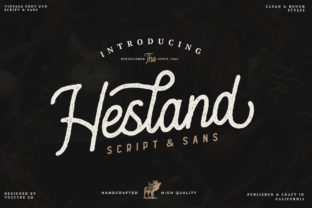
Hesland is a single-weight, handwritten sans-serif font inspired by vintage screen-printed posters: think hand-painted signage from 1940s bookshops, artisanal bakery chalkboards, or community bulletin boards where clarity met warmth. Unlike script fonts that prioritize flourish over function, Hesland prioritizes legibility without sacrificing character. Its letters retain subtle irregularities—slight variations in stroke width, gentle tilt, uneven baseline alignment—that signal human authorship rather than algorithmic precision.
That distinction matters when you’re making decisions about how your message lands. In a landscape saturated with hyper-polished, AI-generated visuals, Hesland introduces intentional friction—a quiet cue that what follows is grounded, considered, and human-made. That’s not nostalgia for its own sake. It’s strategic differentiation.
Where Hesland Adds Real Value—Not Just Visual Polish
Consider three high-leverage use cases where Hesland shifts outcomes—not just appearance:
- Brand positioning for values-driven businesses: A sustainable textile studio, an independent bookstore, or a local ceramics workshop can use Hesland in logo lockups, packaging stamps, or event posters to reinforce craft, care, and continuity—without leaning on clichéd “rustic” tropes.
- Educational and workshop materials: When educators or facilitators use Hesland for slide headers, handout titles, or whiteboard-style infographics, it subtly lowers perceived formality. Learners register less hierarchy and more invitation—especially helpful in adult learning environments where psychological safety supports retention.
- Customer-facing touchpoints with emotional resonance: A thank-you card after a service booking, a limited-edition product label, or a seasonal email header—each becomes more memorable when Hesland replaces sterile system fonts. It signals that this moment was designed, not automated.
How to Use Hesland With Intention—Not Impulse
Using Hesland well requires more than downloading and applying it. It begins with asking: What outcome do I want this text to support? If the answer is “to stand out,” pause. Standing out isn’t the goal—being understood, trusted, or remembered is. Hesland works best when it serves those aims—not when it’s used as decoration.
Start with hierarchy and restraint. Because Hesland carries visual weight, it performs strongest at larger sizes (24pt and up) and in short-form applications: headlines, callouts, logos, signage, or pull quotes. Avoid body copy—it’s not built for extended reading. Pair it with a clean, neutral sans-serif (like Inter, Lato, or even Helvetica Neue) for supporting text. This contrast reinforces clarity while preserving warmth.
Also consider context. Hesland reads as warm, approachable, and analog—but not playful, whimsical, or tech-forward. Using it in a fintech dashboard or a SaaS onboarding flow risks misalignment. It belongs where humanity is part of the value proposition—not where speed, scale, or automation is the primary promise.
Risks of Using Hesland Without Clear Purpose
Without grounding in strategy, Hesland can unintentionally undermine credibility. Its imperfections read as charm only when they feel deliberate—not careless. A poorly kerned headline, inconsistent sizing across platforms, or mismatched color contrast (e.g., light gray Hesland on off-white background) erodes readability and implies inattention to detail.
Worse, using Hesland across too many touchpoints dilutes its impact. When every banner, email subject line, and social graphic features the same handwritten treatment, it stops feeling special—and starts feeling like a crutch. That’s especially true for small teams or solopreneurs operating with limited design bandwidth. Consistency matters, but so does intentionality.
There’s also a subtler risk: mistaking tone for substance. Choosing Hesland won’t make your offer more thoughtful or your service more reliable. It amplifies what’s already there. If your customer experience is fragmented or your messaging unclear, Hesland may highlight those gaps rather than mask them.
Practical Planning Tips for Strategic Implementation
Before integrating Hesland into your workflow, ask yourself three questions:
- What’s the primary action I want the reader to take after seeing this? If it’s to click, sign up, or purchase, ensure Hesland supports—not competes with—that goal. Test button labels in Hesland versus your primary UI font. Does conversion hold? Or does legibility suffer at smaller sizes?
- Does this use case benefit from perceived authenticity—or does it require neutrality? A newsletter header announcing a new course? Yes. A compliance notice in your app’s settings menu? No.
- Can I maintain consistency without overextending? Limit Hesland to one or two defined roles—e.g., “all primary headlines in print collateral” or “logo + social media story text only.” Document those rules. Revisit them quarterly.
Long-Term Value Lies in Discipline, Not Novelty
Hesland endures because it avoids trend-chasing. It doesn’t simulate brushstrokes or mimic calligraphy tools—it reflects how real people write with confidence and economy. That makes it unusually adaptable across mediums: it scales cleanly on large-format prints, holds up in embroidery digitization, and translates well to letterpress or foil stamping.
But its longevity isn’t automatic. It depends on disciplined application—using it where warmth strengthens meaning, not where it distracts from utility. Think of Hesland not as a stylistic shortcut, but as a commitment to a certain kind of communication: unhurried, human-scaled, and quietly confident.
For educators building curriculum, freelancers crafting client proposals, or small business owners defining their first brand guidelines—Hesland offers a rare advantage: it asks you to slow down and decide, deliberately, what voice you want to extend into the world. That decision, repeated consistently, compounds over time. It shapes perception. It builds recognition. It supports trust.
So don’t reach for Hesland because it looks “vintage” or “handmade.” Reach for it when you need to signal that something was made with care—and meant to be received with attention.