Rougher and Rougher: The Hand-Drawn Typeface That Brings Authenticity to Every Project
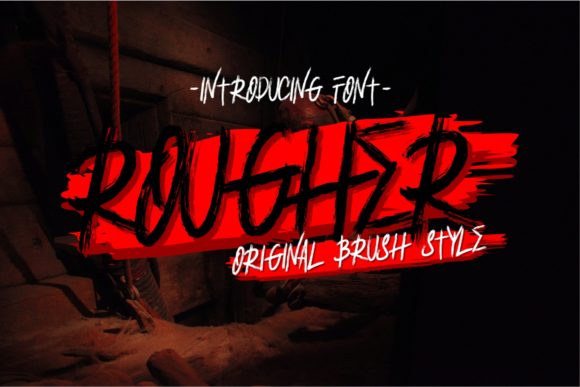
There’s a quiet shift happening across design studios, branding agencies, and indie creators alike: a move away from polished perfection and toward something more human—imperfect, expressive, alive. Enter Rougher and Rougher, a brush handwriting typeface that doesn’t just mimic hand-drawn lettering—it breathes with it. It’s not a simulation. It’s texture, motion, and intention captured in vector form.
What Makes Rougher and Rougher Feel So Real?
At its core, Rougher and Rougher is built on natural stroke variation. Each glyph carries subtle inconsistencies—the kind you’d get from pressing a real brush pen into paper: thicker downstrokes, tapered exits, slight wobbles in curves, and organic entry flicks. These aren’t random glitches; they’re carefully engineered imperfections designed to mirror how people actually write—not how algorithms render “handwritten” fonts.
Unlike many script fonts that rely on rigid alternates or static swashes, Rougher and Rougher uses layered stroke behavior. Letters connect with believable flow—not forced ligatures, but intuitive joins that respond to context. An “a” followed by an “n” doesn’t snap into place; it leans, overlaps slightly, and leaves room for air. That’s street-style authenticity—not studio-tight control.
Where Rougher and Rougher Fits Best (and Where It Doesn’t)
This isn’t a font for body text. And that’s by design. Rougher and Rougher thrives where attention matters most: logos, headers, album art, t-shirt prints, event posters, café signage, and packaging that wants to feel handmade rather than mass-produced.
- Logos: Small businesses, craft breweries, independent bookshops, and wellness studios use Rougher and Rougher to signal approachability and integrity—no stock vectors, no sterile sans-serifs. A coffee roaster named “Hearth & Grind” gains instant warmth with a logo set in Rougher and Rougher, especially when paired with earthy tones and uncoated paper stock.
- Apparel: Screen-printed tees benefit enormously from its tactile rhythm. Because the strokes vary in weight and edge softness, it translates beautifully to ink on fabric—even at medium sizes. No pixelation. No flattening. Just confident, legible grit.
- Digital headers: On websites and social banners, Rougher and Rougher holds up well when exported as SVG or high-res PNG. Its contrast works even against busy backgrounds—especially when layered over grainy textures or muted photography.
That said, avoid using it for interface labels, data tables, or long-form editorial headlines. Its personality is strong—and should remain focused. Think of it like a bold spice: essential in the right dish, overwhelming if overused.
How Designers Are Actually Using It Today
In practice, Rougher and Rougher shows up most often in hybrid workflows. Designers rarely drop it in raw and call it done. Instead, they layer it thoughtfully:
- Pair it with a grounded sans-serif—like Inter, Poppins, or even Helvetica Neue—for balance. The contrast between rough and refined reinforces both voices.
- Add subtle noise or halftone overlays in Photoshop or Figma to deepen the analog feel—especially effective for print mockups or Instagram story graphics.
- Adjust tracking intentionally: Tighten letters for impact in logos (“BOLD”), loosen them for friendly headers (“Welcome Back”). Its spacing was designed to breathe—not compress unnaturally.
- Use color deliberately: Black-on-white gives maximum contrast and clarity. But try deep indigo, charcoal grey, or even brick red for mood-driven projects—colors that enhance, not distract from, its natural stroke texture.
One boutique design studio in Portland recently used Rougher and Rougher across a full rebrand for a local ceramics collective. They applied it to hand-stamped clay tags, embroidered tote bags, and website hero text—all while keeping the same weight and scale. The result? Cohesion without repetition. Recognition without rigidity.
Technical Strengths You’ll Appreciate
Beyond aesthetics, Rougher and Rougher delivers where it counts for working professionals:
- OpenType features include stylistic alternates, contextual ligatures, and swash capitals—giving designers real typographic flexibility without switching fonts.
- Cross-platform compatibility means it renders cleanly in Adobe apps, Figma, Sketch, and even modern web environments via
@font-face(with proper WOFF2 fallbacks). - Optimized hinting ensures legibility at larger display sizes—even on lower-DPI screens—without sacrificing stroke nuance.
- Lightweight file size keeps web performance intact. At under 80KB for the full family (Regular + Bold), it won’t bloat your site’s load time.
No hidden licensing traps either. It’s licensed for commercial use—including merchandise resale—so whether you’re designing for a client’s limited-edition hoodie drop or your own sticker shop, you’re covered.
Why “Street-Style” Isn’t Just a Buzzword Here
“Street-style” gets tossed around a lot—but with Rougher and Rougher, it’s literal. The letterforms echo chalkboard menus, spray-painted murals, zine covers, and handwritten gig posters. There’s no airbrushed uniformity. No AI-smoothed edges. Just the honest push-and-pull of a tool meeting surface.
That resonance matters—especially now. Consumers increasingly favor brands that feel *made*, not manufactured. A food truck’s chalkboard sign in Rougher and Rougher feels immediate and trustworthy. A yoga studio’s workshop flyer gains sincerity. Even digital-native brands use it to soften their presence—to say, “We’re real people behind this.”
Getting Started: Practical Tips for First-Time Users
If you’re new to Rougher and Rougher, start simple:
- Test it at 48pt minimum on screen—and 72pt+ for print. Its character shines when you can see stroke transitions.
- Avoid all-caps for long phrases. Uppercase works brilliantly for short acronyms or initials (“RAW”, “VIBE”, “YES”) but loses rhythm in extended text.
- Watch line height: Set paragraph leading to at least 1.4x the font size. Let those thick downstrokes have room to land.
- Try it in black first before experimenting with color. Its contrast hierarchy is strongest in monochrome—and reveals whether your layout has enough visual breathing room.
And remember: Rougher and Rougher isn’t about hiding polish—it’s about choosing where polish belongs. Use it where humanity should be visible. Save the precision for footnotes, specs, and fine print.
Final Thought: A Font With Intention, Not Just Aesthetic
In an era saturated with generative tools and algorithmically “perfect” type, Rougher and Rougher stands out by refusing to erase the hand. It doesn’t simulate spontaneity—it encodes it. Every curve, every taper, every slight tremor says: This was made by someone who chose this mark, right here, for a reason.
That intention transfers. To your audience. To your brand. To your process. Whether you're sketching a logo concept at 2 a.m. or finalizing a merch line for launch day, Rougher and Rougher meets you where authenticity begins—with the stroke.