The Witch
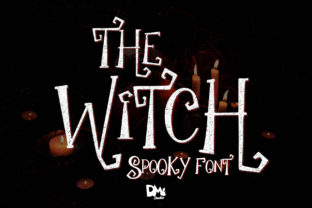
The Witch is a distinctive handwritten display font designed with Halloween in mind—but its utility extends well beyond seasonal greetings. Released as a commercial typeface, it balances playful eccentricity with typographic intentionality, making it more than just a novelty. Unlike many thematic fonts that sacrifice legibility or versatility for atmosphere, The Witch maintains a consistent rhythm and structural coherence across its character set, which supports real-world application in branding, publishing, and digital design.
What Makes The Witch Stand Out
At first glance, The Witch reads as spontaneous and slightly unruly—slanted letterforms, uneven baselines, variable stroke widths, and subtle ink blots or tapering terminals all reinforce its handmade aesthetic. Yet this looseness is carefully calibrated. Each glyph was drawn by hand and then digitized with attention to spacing, kerning pairs, and OpenType features (including ligatures and stylistic alternates), ensuring it behaves predictably in professional layout environments.
Its uppercase letters carry expressive weight—ideal for headlines, signage, or logo lockups—while the lowercase set remains legible at moderate sizes (16–24 pt) when used in short bursts: event posters, social media banners, packaging accents, or chapter titles in themed publications. It includes standard Latin characters, numerals, punctuation, and basic diacritics, covering most English-language use cases without requiring fallback fonts.
Practical Performance in Real Projects
In practice, The Witch performs best where visual tone matters more than dense text flow. A café launching a “Potion Hour” autumn menu used it for chalkboard-style window decals and Instagram story highlights—paired with a clean sans-serif for body copy—to signal whimsy without compromising readability. Similarly, an independent publisher applied it to spine titles and section dividers in a limited-edition anthology of gothic short fiction; readers noted the font enhanced immersion without distracting from narrative pacing.
It holds up reliably in print: its generous x-height and open counters prevent ink spread on uncoated paper, and its weight distribution avoids pixelation at common web resolutions (72–96 dpi). When exported as SVG or embedded via @font-face, it renders consistently across modern browsers—though designers should test rendering on Windows systems, where legacy hinting may occasionally soften fine details in smaller sizes.
Strengths and Limitations
Strengths:
- Distinctive voice: Offers immediate thematic recognition without relying on clichéd motifs (e.g., bats, cauldrons, or exaggerated serifs).
- Cross-platform stability: Available in OTF and WOFF2 formats with full Unicode coverage for Western European languages.
- Workflow integration: Works natively in Adobe Creative Cloud apps, Affinity Suite, Figma, and Google Fonts-compatible platforms (when self-hosted).
- Brand alignment: Supports cohesive identity systems—especially for businesses or creators building around mystery, storytelling, craft, or curated experience.
Limitations:
- Not suitable for long-form text: Lacks true italic variants or small caps, and its irregular metrics reduce scanning efficiency beyond ~30 characters per line.
- Narrow contextual fit: Less effective for corporate reports, academic journals, or healthcare communications where neutrality and clarity are prioritized.
- Requires thoughtful pairing: Clashes easily with overly decorative or similarly high-contrast fonts; benefits from contrast—e.g., pairing with a geometric sans like Montserrat or a warm humanist face like Lora.
Audience Fit: Who Benefits Most?
The Witch serves professionals who need to communicate mood quickly and memorably—not just those planning October campaigns. Educators designing classroom escape-room activities find it effective for clue cards and puzzle headers. Indie game developers use it for UI elements in narrative-driven horror or mystery titles, where typography contributes to world-building. Small business owners running artisanal apothecaries, tarot studios, or vintage bookshops apply it to business cards and website headers to signal authenticity and niche appeal.
Freelance designers report using The Witch most often in three scenarios: (1) client projects with defined seasonal windows (e.g., Halloween pop-ups, holiday markets); (2) personal brand assets where personality outweighs formality (e.g., newsletters, Patreon banners); and (3) editorial layouts where typographic contrast reinforces hierarchy—such as pull quotes in lifestyle blogs covering folklore, sustainable living, or creative wellness.
Usability and Technical Considerations
Installation is straightforward: drag-and-drop into system font folders or activate via cloud font managers. Licensing is typically perpetual per user or site, with clear terms for desktop, web, and app embedding—no subscription required. That said, users should verify license scope before deploying in SaaS products or white-labeled tools where redistribution occurs.
Kerning is tight but not over-engineered—some manual adjustment may be needed for specific word combinations (e.g., “Witchcraft” or “Bewitched”), particularly in larger display settings. The font includes discretionary ligatures (like “th” or “ff”) that enhance flow in headlines but can be toggled off if preferred. No variable axis is offered, so weight or width adjustments require selecting alternate styles if provided by the foundry.
Long-Term Value and Design Integrity
Unlike trend-dependent fonts that feel dated within months, The Witch draws from enduring traditions of sign painting, Victorian broadsides, and early 20th-century circus typography—giving it staying power beyond a single season. Its imperfections are intentional, not technical compromises: slight variations in slant and pressure mimic natural hand movement, avoiding the sterile uniformity of algorithmically generated scripts.
That integrity translates to longevity in brand systems. One Etsy seller reported reusing The Witch across four years of product launches—from candle labels to email headers—without audience fatigue, attributing this to consistent application (always paired with the same neutral secondary font and color palette) rather than overexposure.
When to Choose—or Skip—The Witch
Choose The Witch if your goal is to evoke curiosity, warmth, or quiet mischief—not fear or aggression. It works especially well when your audience values craft, individuality, or tactile sensibility. Avoid it if your project demands strict accessibility compliance (its irregular forms lower WCAG contrast scores in some configurations) or if you’re working under tight brand guidelines that prohibit display fonts in primary messaging.
For teams evaluating multiple Halloween-themed fonts, The Witch stands out for its balance of character and control. It doesn’t force a theme—it invites interpretation. That makes it less of a prop and more of a tool: one that supports voice without overriding content, enhances design without demanding attention, and delivers seasonal resonance without locking you into a single month’s aesthetic.