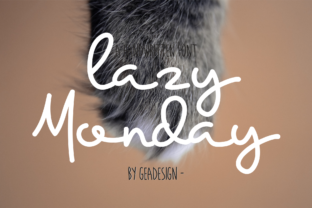
Lazy Monday: The Playful Handwritten Font That Makes Every Word Feel Like a Smile
There’s something instantly disarming about handwriting — the slight tilt, the gentle curves, the subtle imperfections that whisper “human.” Lazy Monday captures that warmth with remarkable authenticity. It’s not just another script font; it’s a cheerful, relaxed, and unmistakably playful handwritten typeface with a light script touch — like your favorite friend jotting down notes on a napkin, but polished enough for real-world use.
What Makes Lazy Monday Stand Out?
At first glance, Lazy Monday feels effortlessly casual — but its charm is intentional. Designed with organic stroke variation and soft terminals, it balances legibility with personality. Unlike tightly wound calligraphic fonts or overly decorative scripts, Lazy Monday avoids visual clutter. Its letters flow naturally, with generous spacing and open counters that keep text airy and readable — even at smaller sizes.
Key characteristics include:
- Gentle rhythm: Letters connect subtly (but not obligatorily), allowing both connected and spaced usage depending on context.
- Warm, rounded forms: No sharp angles — just friendly curves that invite engagement.
- Consistent baseline: Stays grounded, avoiding the wobbly unpredictability that can hinder readability in other handwritten fonts.
- Light script influence: A delicate nod to traditional penmanship without demanding formal technique or sacrificing modern usability.
Who Benefits Most from Lazy Monday?
This isn’t a one-size-fits-all font — and that’s part of its strength. Lazy Monday shines brightest when you want to soften tone, add approachability, or signal creativity without shouting. Here’s who finds it especially useful:
- Creatives & Designers: Illustrators, lettering artists, and branding designers reach for Lazy Monday when building mood boards, crafting social media visuals, or designing invitations where warmth matters more than formality.
- Small Business Owners: Cafés, boutiques, wellness studios, and handmade goods sellers use Lazy Monday to reflect their authentic, human-centered ethos — on menus, packaging labels, or Instagram story highlights.
- Educators & Coaches: Those who teach online courses, lead workshops, or share mindful content often choose Lazy Monday for handouts or slide headers — it feels inviting, not intimidating.
- Content Creators: Bloggers, newsletter writers, and podcasters embed Lazy Monday into graphics to break up dense text, highlight quotes, or add visual texture to otherwise static layouts.
Where Does Lazy Monday Work Best — and Where Should You Pause?
Great fits:
- Short-form headlines and quotes: A blog title like “Your Monday Doesn’t Have to Be Heavy” gains instant charm in Lazy Monday.
- Branded merchandise: Tote bags, stickers, or enamel pins featuring hand-drawn phrases feel cohesive and genuine with this font.
- Digital storytelling: In Canva or Figma mockups, Lazy Monday adds expressive contrast next to clean sans-serifs like Inter or Lato — creating hierarchy through personality, not just size.
- Email subject lines (as image text): When used sparingly and accessibly (with alt text!), it boosts open rates by standing out in crowded inboxes.
Less ideal for:
- Long paragraphs or body copy: While highly legible at 16–24px, extended reading in Lazy Monday can tire the eye. Save it for emphasis, not endurance.
- Formal documents or legal disclaimers: Its playful nature may unintentionally undercut seriousness or authority.
- Low-resolution displays or tiny mobile buttons: Fine details (like thin crossbars or delicate joins) may blur or disappear below ~14px on older screens.
Real-World Moments Where Lazy Monday Adds Real Value
Consider these everyday scenarios — no design degree required:
A local yoga studio launches a new “Slow Mornings” workshop series. Instead of using a generic script font, they pair Lazy Monday with a neutral serif for event posters. The result? Calm, intentional, and quietly joyful — aligning perfectly with their message.
An indie stationery brand releases a planner with inspirational prompts. They use Lazy Monday for section headers (“Breathe In,” “Pause Here,” “Try This”) — turning functional cues into gentle nudges. Customers report feeling “seen” before they even write a word.
A freelance writer builds her website portfolio. She uses Lazy Monday only for her tagline — “Words that land softly, then stay.” Visitors immediately grasp her voice: empathetic, precise, unhurried. It becomes her unspoken signature.
How to Evaluate If Lazy Monday Fits *Your* Project
Before downloading or licensing, ask yourself three simple questions:
- What emotion do I want this text to carry? If “friendly,” “thoughtful,” “creative,” or “relaxed” tops your list — Lazy Monday is likely a strong candidate.
- How much space will it occupy? Is it a single headline, a logo lockup, or a full-page layout? Lazy Monday thrives in focused roles — not as an all-purpose workhorse.
- Who’s reading it — and where? If your audience skims on mobile, test it at 18px on multiple devices. If it’s printed on kraft paper for a farmers’ market booth, print a sample — the texture enhances its handmade feel.
Pro tip: Pair it thoughtfully. Lazy Monday sings alongside clean, open sans-serifs (like Poppins or Nunito) or warm serifs (like Cormorant Garamond). Avoid pairing it with other high-contrast scripts or ultra-thin fonts — the contrast should elevate, not compete.
Final Thoughts: More Than Just a Font — It’s a Tone Setter
Choosing a font isn’t just about aesthetics — it’s about emotional resonance. Lazy Monday doesn’t try to impress with complexity. Instead, it offers sincerity, ease, and quiet confidence. It says, “I’m here to connect — not convince.”
That makes it unusually versatile for people who value clarity *and* character: teachers explaining tough concepts, founders launching values-driven brands, artists sharing personal stories, or anyone who believes good communication starts with making people feel welcome.
So yes — Lazy Monday is playful. Yes — it’s handwritten, with that lovely script touch. But its real superpower? Making professionalism feel human, and creativity feel accessible. Whether you’re drafting a heartfelt note or designing a launch campaign, it reminds us that sometimes, the coolest thing you can do is simply show up — gently.