Midnight Siganture: The Handwritten Font That Feels Like a Real Signature
There’s something instantly trustworthy—and deeply human—about a handwritten signature. It carries weight, intention, and personality in a single fluid stroke. That’s why Midnight Siganture stands out in today’s digital design landscape: it doesn’t just mimic handwriting—it captures the rhythm, variation, and subtle imperfections of a real pen moving across paper. Whether you’re crafting a wedding invitation, branding a boutique skincare line, or designing a premium product label, Midnight Siganture delivers authenticity without compromise.
Why “Natural Flow” Matters More Than You Think
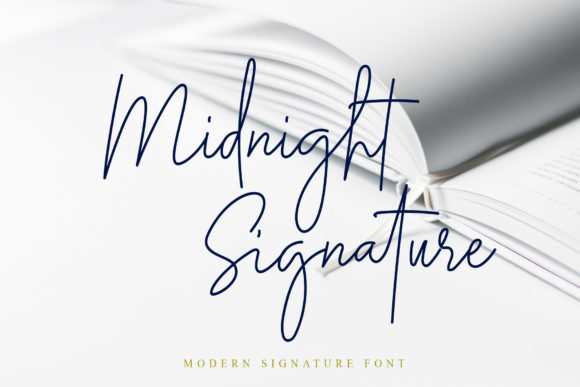
Not all script fonts feel genuine. Many rely on rigid spacing, uniform letter heights, or overly symmetrical curves—telling visual cues that scream “digital,” not “hand-drawn.” Midnight Siganture, by contrast, was designed with organic movement in mind. Its letters connect with gentle, asymmetrical joins. Some ascenders stretch slightly higher; some descenders dip with soft confidence. There’s slight variation in stroke thickness—not mechanical, but expressive, like ink bleeding just a little under pressure.
This natural flow isn’t just aesthetic. It affects perception. Studies in visual psychology show that viewers subconsciously associate irregular, hand-rendered forms with sincerity, care, and individuality. When your logo, packaging, or social media graphic uses Midnight Siganture, it signals thoughtfulness—not automation.
Where Midnight Siganture Fits Best (and Where It Doesn’t)
Midnight Siganture thrives in contexts where warmth, elegance, or personal connection is the goal. Think:
- Wedding stationery — From save-the-dates to menu cards, its graceful lines evoke romance and intentionality.
- Luxury branding — Artisanal coffee roasters, small-batch candle makers, and independent perfumers use it to reinforce craftsmanship and story.
- Personalized gifts — Engraved jewelry tags, custom mugs, or framed quotes gain emotional resonance when rendered in Midnight Siganture.
- Digital signatures in presentations or proposals — Replaces sterile typed names with something that feels signed, sealed, and trusted.
That said, Midnight Siganture isn’t built for everything. It’s not ideal for body text, legal disclaimers, or data-heavy infographics. Its decorative nature means legibility drops at very small sizes or low-resolution outputs. If your project demands scannability above all—like safety instructions or app interface labels—reach for a clean sans serif instead.
How Designers Are Using Midnight Siganture Right Now
Real-world usage reveals smart adaptations. One Brooklyn-based branding studio uses Midnight Siganture exclusively for client sign-offs—embedding it into PDF proposal covers as a “digital autograph.” It’s not legally binding, but psychologically, it transforms a transaction into a collaboration.
A Portland-based stationer layers Midnight Siganture over watercolor backgrounds, then adjusts opacity and tracking to create depth—never letting the font compete with texture, always letting it breathe. Another designer pairs it with Inter or Manrope for contrast: the script handles emotion; the sans serif handles clarity.
And yes—people are using it in motion graphics. With variable font support (where available) or thoughtful keyframing in After Effects, animators replicate the sensation of ink appearing stroke-by-stroke. That subtle “writing-in” effect? It’s become a quiet trend in premium explainer videos and brand intros.
Technical Considerations Before You Install
Before dropping Midnight Siganture into your next Figma file or Adobe Illustrator document, consider these practical factors:
- Licensing: Check whether your intended use—especially for client work or merchandise—is covered. Some licenses restrict web embedding or resale in templates. Always verify with the foundry or marketplace where you purchase it.
- File formats: Most versions include OTF and TTF, but high-end variants may offer OpenType features like discretionary ligatures, swashes, or stylistic alternates. These aren’t gimmicks—they’re tools. A well-placed swash on a capital “S” or “Q” can elevate an entire layout.
- Cross-platform rendering: While Midnight Siganture renders beautifully in design apps, preview how it appears in email clients or older browsers if used in live web headers. For web use, pair it with a fallback font and test on iOS, Android, and desktop Safari/Chrome.
- Kerning adjustments: Even great scripts sometimes need manual tuning. Pay attention to problematic pairs like “To”, “Wa”, or “Fr”. A slight negative kern can restore rhythm where the default spacing feels loose.
Pairing Midnight Siganture Thoughtfully
Great pairing isn’t about contrast alone—it’s about shared values. Midnight Siganture leans warm, confident, and quietly refined. So avoid clashing energies: no harsh geometric sans serifs with rigid corners, and no ultra-thin delicate fonts that vanish beside its presence.
Instead, try:
- With serif companions: Playfair Display or IBM Plex Serif—both offer enough structure to ground Midnight Siganture without dulling its spark.
- With humanist sans serifs: FF Meta, Lato, or Work Sans. Their open forms and gentle curves echo the script’s friendliness.
- In monochrome layouts: Pairing Midnight Siganture with charcoal gray and off-white creates sophistication without distraction—ideal for luxury e-commerce banners or editorial mastheads.
Real Impact: What Clients Notice (and Remember)
Designers report a consistent pattern: when they swap generic script fonts for Midnight Siganture in client presentations, feedback shifts. Instead of “It looks nice,” they hear “That feels like *us*,” or “I can imagine signing this myself.” That shift—from visual approval to emotional alignment—is where Midnight Siganture earns its keep.
One freelance designer shared how a local bakery rebranded using Midnight Siganture for their tagline (“Baked with love since 1987”). Foot traffic increased 12% over three months—not because the font sold croissants, but because customers reported feeling “more welcomed,” “more personally invited in.” The font didn’t change the product—but it changed the relationship.
Final Thought: Authenticity Isn’t Just Stylistic—It’s Strategic
In an era of AI-generated visuals and templated layouts, choosing a font like Midnight Siganture is a quiet act of intention. It says: we value the human touch. We invest in detail. We want our audience to feel seen—not just addressed.
It won’t fix weak copy or poor UX. But in the right context—with careful pairing, appropriate sizing, and mindful application—Midnight Siganture adds irreplaceable warmth. Not as decoration. As voice.
If your next project calls for sincerity, elegance, or a whisper of nostalgia—without veering into cliché—Midnight Siganture isn’t just another font choice. It’s a signature move.