Rendering: A Handwritten Font That Feels Human in a Digital World
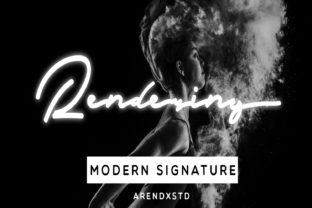
In an era where interfaces grow sleeker, algorithms more predictive, and templates increasingly standardized, something quietly powerful is gaining momentum: authenticity. Not as a buzzword—but as a tangible quality people seek in visual communication. Rendering stands out not because it’s technically advanced or loaded with features, but because it carries warmth, rhythm, and intentionality in every glyph. It’s a casual, yet cool handwritten font with an organic feel—designed to add a personal touch to any design idea without demanding attention for its own sake.
What Makes Rendering More Than Just Another Script Font?
Rendering isn’t trying to mimic calligraphy masters or replicate ink bleed on parchment. Instead, it captures the subtle imperfections of real handwriting—the slight variation in stroke weight, the gentle tilt of letters, the way “a” and “g” sit just a little lower than their neighbors. These aren’t flaws; they’re cues our brains read as human. That distinction matters. When viewers encounter text set in Rendering, they don’t pause to analyze letterforms—they relax into the message. That psychological shift—from scanning to connecting—is rare in digital typography.
Unlike many script fonts that prioritize flourish over function, Rendering balances legibility with character. Its lowercase “e” opens generously. Its “t” has a soft, tapered crossbar—not rigid, not fussy. Even at smaller sizes (14–16px), it holds up well in body copy for newsletters, blog sidebars, or app onboarding screens. That versatility makes it practical—not just decorative.
Why Now? The Shift Toward Intentional Typography
Design trends rarely pivot on aesthetics alone. They respond to behavior. Over the past five years, we’ve seen users grow more sensitive to tone—especially in spaces where trust and clarity matter most: email marketing, educational platforms, small-business websites, and even internal team tools. A generic sans-serif may communicate efficiency, but it doesn’t signal care. A sterile display font might look modern—but it can also feel distant.
At the same time, creative workflows have become more distributed and iterative. Designers, marketers, and educators often collaborate across tools—Figma, Canva, Notion, Google Docs—and need fonts that translate consistently without requiring custom kerning or manual adjustments. Rendering works natively in most modern web environments and supports OpenType features like contextual alternates, meaning letters adapt slightly depending on their neighbors—a detail that deepens the organic impression without extra effort.
Real-World Uses That Go Beyond “Just Nice Looking”
Consider a freelance educator launching a new workshop series. Their landing page needs to balance credibility with approachability. Using Rendering for headlines and short pull quotes—paired with a neutral sans-serif for body text—creates visual hierarchy *and* emotional resonance. Visitors don’t just see “Learn Creative Writing”—they sense “Someone thoughtful crafted this for you.”
Or take a local coffee roaster building a Shopify store. Product descriptions written in Rendering—on packaging mockups, Instagram story highlights, or email headers—don’t scream “handmade” in a clichéd way. Instead, they suggest craft, attention, and continuity across touchpoints. Customers report feeling “recognized,” not marketed to—because the voice feels consistent, not algorithmically optimized.
Even in professional contexts like internal dashboards or HR onboarding kits, Rendering serves a quiet purpose: reducing cognitive load through familiarity. A welcome message in Rendering feels less like a system alert and more like a note from a colleague. That small shift supports psychological safety—especially important in hybrid or remote teams where tone is harder to convey.
How Rendering Fits Into Evolving Creative Practices
Typography used to be the domain of specialists. Today, it’s part of everyday communication—whether you’re drafting a Substack post, designing a Canva presentation, or annotating a Figma prototype. As tools democratize design, the demand for typefaces that “just work” has grown. Rendering answers that need by prioritizing usability alongside expressiveness.
It’s also responsive to how people consume content across devices. On mobile, where screen space is limited and attention fragmented, Rendering’s open counters and generous spacing help maintain readability—even when users skim. And unlike some handwritten fonts that collapse into illegibility below 18px, Rendering remains distinct at 14px in interface labels or captioned social posts.
Importantly, it avoids trend fatigue. While “grunge,” “neon,” or “retro-futurist” fonts cycle in and out of relevance, Rendering leans into timelessness—not by being neutral, but by being grounded in human gesture. That gives it staying power beyond seasonal campaigns or platform-specific aesthetics.
Practical Considerations for Choosing—and Using—Rendering
Like any tool, Rendering shines brightest when matched to intent—not applied universally. It excels in moments where you want to emphasize voice: testimonials, author bios, handwritten-style annotations, brand slogans with emotional weight (“Made with care,” “Built for you,” “Let’s begin”). It’s less suited for dense legal disclaimers or data-heavy tables—situations where neutrality and precision outweigh personality.
Pairing matters. Rendering harmonizes naturally with humanist sans-serifs (like Inter, Manrope, or IBM Plex Sans) and low-contrast serifs (such as PT Serif or Charter). Avoid pairing it with geometric sans-serifs (Helvetica Neue, Montserrat) unless you’re intentionally creating contrast—for example, using Rendering for a headline and Montserrat for navigation to highlight difference in function.
Color use also affects perception. Rendering gains warmth in muted earth tones (terracotta, olive, charcoal gray) and feels crisp in deep navy or black on off-white backgrounds. Avoid high-saturation neon palettes unless your brand deliberately embraces playful disruption—Rendering’s strength lies in subtlety, not shock value.
Looking Ahead: Typography as a Quiet Signal of Values
As AI-generated visuals become more accessible—and sometimes indistinguishable from human-made ones—the value of intentional, human-rooted design choices will only increase. Rendering doesn’t resist technology; it complements it. It’s a reminder that tools serve people, not the other way around. When you choose Rendering, you’re not selecting a font—you’re choosing a stance: one that values nuance over noise, connection over conversion, and craft over convenience.
That stance resonates across industries. A therapist’s website using Rendering for session descriptions signals empathy before a word is read. A nonprofit’s annual report uses it in donor thank-you notes to reinforce gratitude as lived experience, not transaction. A developer documenting an open-source tool applies it to release notes—not to obscure technicality, but to humanize the labor behind the code.
None of this requires expertise in typography theory. It simply asks for attention—to how words land, how tone travels, and how much weight a single typeface can carry when chosen with purpose. Rendering doesn’t shout. But in the right context, it speaks clearly.
Final Thought: Start Small, Stay Intentional
You don’t need to overhaul your entire design system to explore Rendering. Try it in one place where voice matters most: your email signature, your portfolio “About” section, or the subtitle on your latest blog post. Notice how it changes the rhythm of the page—not just visually, but emotionally. That awareness is the first step toward more meaningful, human-centered communication. And in a world saturated with sameness, that kind of intention is anything but casual.