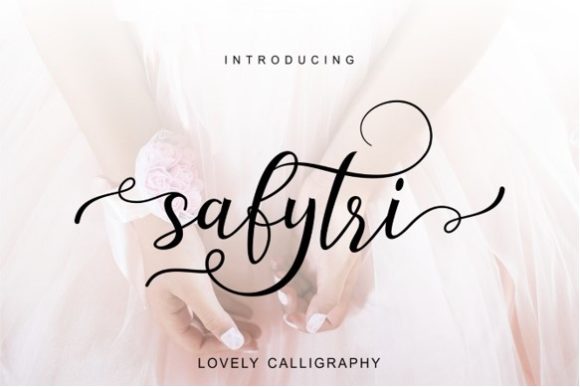
Safytri: Where Script Typography Meets Intentional Expression
Typography is no longer just about legibility—it’s about resonance. In a digital landscape saturated with uniform sans-serifs and algorithmically optimized UI fonts, designers, marketers, and independent creators are increasingly turning to script typefaces not as decorative afterthoughts, but as strategic tools for differentiation. Safytri stands apart in this shift: a highly original script font built around expressive control, not just flourish. Its defining feature isn’t merely the presence of swashes—but their thoughtful placement, natural rhythm, and contextual responsiveness. That distinction matters, especially now.
Why Script Fonts Are Reclaiming Creative Authority
Over the past five years, we’ve seen a quiet but steady reversal in typographic preference. Early 2010s minimalism prized neutrality; today’s audiences respond more readily to authenticity—hand-drawn textures, variable weight transitions, and letterforms that suggest human intention. This isn’t nostalgia—it’s a reaction to homogenized interfaces and AI-generated content that often lacks tactile nuance. Script fonts like Safytri fill that gap precisely because they carry subtle evidence of craft: the slight taper of an entry stroke, the controlled tension in a terminal loop, the way a lowercase g or y extends with purpose rather than ornamentation.
Brands no longer default to “friendly” sans-serifs to signal approachability. Instead, they’re using considered scripts to communicate warmth *without* cliché—think artisanal food packaging that avoids cursive caricature, or a wellness newsletter whose headline font feels grounded, not frivolous. Safytri supports that intentionality: its swashes are optically balanced, not exaggerated. They connect letters without sacrificing readability at medium sizes, and they scale cleanly from social banners to printed business cards.
How Safytri Fits Modern Workflows—Without Friction
Many script fonts fail in practice—not because they’re unattractive, but because they demand excessive manual kerning, lack OpenType features for automatic alternates, or break in responsive layouts. Safytri was designed with contemporary production realities in mind. It includes standard and discretionary ligatures, initial and terminal swash variants, and stylistic sets that let users toggle between restrained and expressive versions—all within native design apps (Figma, Adobe Creative Cloud, Affinity Suite) and modern web environments via variable font support.
This matters for freelancers juggling three client projects before lunch, educators building accessible slide decks, or small-business owners updating their Shopify store themselves. You don’t need a typography degree to use Safytri well. A marketer can apply its “Swash Alternates” set to a hero headline in 30 seconds—and instantly elevate perceived brand care. A blogger can pair it with a clean, neutral text face (like Inter or IBM Plex Sans) for contrast that feels intentional, not chaotic.
Real-world example: A ceramicist launching an online workshop series used Safytri for her course title (“Clay & Continuity”) and kept body copy in a modest serif. The result? Immediate visual hierarchy, emotional tone aligned with her teaching philosophy (grounded yet fluid), and zero complaints about load time or rendering glitches—even on older iOS devices.
Swashes Done Right: Function Before Flash
Swashes are often misunderstood. When overused, they distract. When under-engineered, they look tacked-on. Safytri treats them as extensions of letterform logic—not embellishments. Each swash emerges naturally from stroke direction and pressure implied by the base glyph. The uppercase S, for instance, doesn’t just trail off—it leans into momentum, guiding the eye forward. Lowercase f and l offer graceful descenders that work in both tight line spacing and generous leading.
This functional approach aligns with current accessibility best practices. Unlike many display scripts, Safytri maintains clear character distinction—even in its most decorative forms. The a doesn’t collapse into the e; the r retains its spine. That means it can serve dual roles: as a high-impact logo lockup *and* as a readable subheading in a presentation deck. No redesign needed when context changes.
Practical Integration Across Roles
Different users engage with Safytri differently—not because it’s niche, but because it’s flexible:
- Freelancers and agencies use it to rapidly prototype brand identities where personality must land in the first 10 seconds—especially for lifestyle, beauty, education, or creative service clients.
- Educators and trainers apply it to workshop titles and certificate headers, adding visual warmth without undermining professionalism.
- Small retailers and makers rely on it for product labels and Instagram story text overlays—where clarity and charm coexist under tight space constraints.
- Bloggers and newsletter writers deploy it selectively: a single word in a subject line (“You’re invited”), a section divider, or a signature tagline—never full-body text, but always with impact.
The key is restraint paired with precision. One user—a UX researcher creating stakeholder reports—shared that she uses Safytri only for research question headers (“What motivates long-term habit change?”). That small touch signals qualitative depth before the reader even scans the bullet points below.
Not Just for “Creative” Projects—A Tool for Clarity
There’s a misconception that expressive fonts belong only in branding or editorial contexts. In reality, Safytri proves useful wherever tone shapes understanding. Consider internal company announcements: a rebrand rollout email with Safytri in the subject line and header immediately signals evolution—not just change. Or a nonprofit’s donor impact report: using Safytri for milestone headings (“2023: 47 Communities Supported”) adds humanity to data without softening its authority.
What makes this possible is Safytri’s underlying structure. Its x-height is generous, its counters open, and its contrast moderate—not extreme like calligraphic revivals. That balance allows it to function where other scripts falter: in dark-mode interfaces, on textured backgrounds, or alongside icons and illustrations without competing for attention.
Looking Ahead—Typography as Quiet Strategy
As AI tools accelerate layout generation and template-based design, the value of human-curated detail rises—not falls. Safytri reflects that shift: it doesn’t replace judgment; it rewards it. Choosing where to activate a swash, which stylistic set suits a particular audience, or how much leading to add beneath a Safytri headline—all these micro-decisions accumulate into macro-level perception.
We’re moving past “font as decoration” toward “font as interface.” And interfaces that feel considered, not automated, earn trust faster. That’s why Safytri resonates across sectors: it supports voice without overriding message, expresses character without obscuring content, and adapts to platforms without compromising integrity.
It won’t solve every design challenge. But when your goal is to make something feel unmistakably *yours*—whether it’s a pitch deck, a wedding invitation, a podcast cover, or a community newsletter—Safytri offers a rare combination: originality with usability, flair with function, and distinctiveness with discipline.