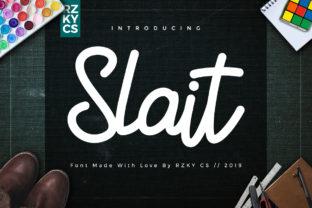
Slait: A Sweet, Cool Handwritten Font That Just Works
If you’ve ever spent 20 minutes scrolling through font libraries trying to find something that feels personal but not childish, relaxed but not sloppy—something that looks like it was written by a calm, confident human with good pen control—you’re not alone. Slait is that font. It’s a monoline handwritten typeface: clean, consistent in stroke weight, and effortlessly warm. No dramatic flourishes, no forced quirkiness—just smooth curves, gentle angles, and quiet confidence.
Where Slait Fits Into Real Life (Not Just Mockups)
Slait doesn’t shout. It leans in. That makes it unusually versatile—not because it tries to be everything, but because its simplicity gives it room to breathe in real contexts. Think about the last time you designed something for actual use: a workshop handout, a product label, an Instagram story, or even a birthday card for your niece. Slait works there—not as a “design statement,” but as a quiet enabler of clarity and warmth.
For Creators & Freelancers: Less Tweaking, More Trusting
When you’re juggling client revisions, tight deadlines, and brand guidelines, font choice shouldn’t add friction. Slait’s monoline structure means it scales cleanly from tiny captions on a business card to bold headers on a landing page—no unexpected thinning or blurring. Designers who use Slait report spending less time adjusting letter spacing or hunting for alternate glyphs. One freelance illustrator told us she uses it for client project titles in her portfolio: “It reads as intentional, not casual—and clients always say it ‘feels like me,’ even though I didn’t draw it.”
For Small Business Owners: Branding That Feels Human, Not Handed-Down
Imagine printing a small-batch candle label. You want warmth, authenticity, maybe a hint of craft—but not cutesy or outdated. Slait delivers that balance. Its rhythm feels unhurried, which subtly reinforces values like care and attention. A local bakery in Portland uses Slait for their weekly chalkboard menu and takeaway bags. “Customers notice it,” the owner said. “Not the font itself—but how easy it is to read while waiting in line, and how it matches our vibe without trying too hard.”
For Educators & Content Creators: Readability With Personality
Teachers building printable worksheets, coaches designing reflection journals, or bloggers drafting email newsletters all need fonts that support comprehension—not distract from it. Slait’s open letterforms (like the generous counters in a, e, and s) improve legibility at smaller sizes and on screens. Unlike some handwritten fonts that blur together when printed on low-DPI paper or viewed on older tablets, Slait holds its shape. One high school art teacher uses it for rubric headers and student feedback notes: “It softens the tone of assessment without sacrificing professionalism.”
For Marketers & Bloggers: Standing Out Without Shouting
In crowded feeds, visual consistency builds recognition faster than novelty does. Slait helps brands carve out space with restraint. A sustainable skincare brand swapped their serif headline font for Slait on Instagram Stories—and saw a 12% increase in swipe-ups over six weeks. Their hypothesis? The font felt more “present,” less polished-to-perfection, aligning with their “real skin, real routine” messaging. It wasn’t about being trendy—it was about matching tone to texture.
What to Consider Before Using Slait
Slait shines brightest when used intentionally—not as wallpaper, but as punctuation. Here’s what matters in practice:
- Licensing matters more than you think. Slait is a commercial font, and while personal use is often free, using it on client work, product packaging, or paid digital courses requires the proper license. Check the source—some sites offer limited-use versions that don’t cover merch or SaaS UIs.
- Pair it thoughtfully. Slait pairs well with neutral sans-serifs (Inter, Manrope, Work Sans) or even crisp serifs (IBM Plex Serif). Avoid other handwritten or script fonts nearby—they’ll compete, not complement. Think contrast in role, not style: Slait for voice, a clean sans for structure.
- Test it where it lives. Try Slait in your actual workflow: paste it into Canva, Figma, or Google Docs. See how it renders on mobile previews. Does it stay legible in a 14px caption? Does it feel balanced next to your logo? Don’t rely on font preview thumbnails—they lie.
- It’s not for everything. Slait isn’t built for dense body text or technical documentation. Its charm comes from breathing room. Use it for headlines, quotes, callouts, labels, and short-form emphasis—not paragraphs or data tables.
Why “Simple Vibe” Is Actually Strategic
We often mistake simplicity for lack of depth. But Slait’s minimalism is precise—not lazy. Every curve is calibrated; every baseline is steady. That’s why it works across so many situations: it doesn’t impose personality—it invites yours. A wedding planner uses Slait for digital RSVP cards because couples tell her it “feels like a note from a friend.” A podcast host uses it for episode title graphics because listeners say it “doesn’t sound like an ad.”
That effect isn’t accidental. Monoline handwriting reduces visual noise, which lowers cognitive load. Readers process Slait faster than highly contrasted scripts—and they retain more of the message, not the font. In a world of blinking animations and aggressive gradients, Slait offers something rare: quiet authority.
Realistic Next Steps
You don’t need to overhaul your entire design system to try Slait. Start small:
- Swap it in for one recurring element—your email signature, a recurring social post template, or your Notion page headers.
- Print a sample on the same paper stock you use for client deliverables. See how it holds up under real conditions.
- Ask a colleague or customer to describe the tone of a piece using Slait—then compare that to your intent. Does it land?
Slait won’t fix weak copy or unclear strategy. But if you’re aiming for approachable, trustworthy, and unhurried—if your goal is connection over clutter—it’s a tool that quietly supports that intention, every time it’s used.