Swirly Kids: A Textured Brush Font with Contemporary Charm
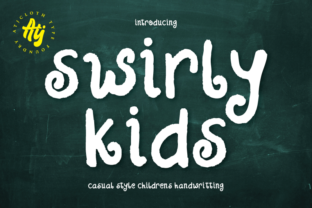
Swirly Kids is a hand-drawn, textured brush font designed to evoke spontaneity and warmth. It features uneven stroke widths, subtle ink bleed, and slight variations in letterform rhythm—hallmarks of authentic brushwork. Unlike highly polished script fonts, Swirly Kids embraces organic imperfection while maintaining legibility at moderate sizes. Its lowercase letters often include playful swirls and tapered terminals, and its uppercase forms retain a casual, unrehearsed energy. It is not a variable font and does not include stylistic alternates or extensive language support beyond basic Latin characters.
Why Designers Consider Swirly Kids
Designers exploring type for expressive, human-centered projects often look for fonts that communicate personality without sacrificing clarity. Swirly Kids appeals in contexts where approachability, creativity, or youthfulness are priorities—such as children’s book illustrations, boutique packaging, educational materials for early learners, or branding for creative studios and indie makers. Its texture adds visual interest in print and digital mockups alike, especially when paired with ample white space and minimal supporting type.
Interest in Swirly Kids typically arises during phases of visual exploration—when a designer has moved past generic sans-serifs and is seeking something more tactile and intentional. It is not chosen for neutrality or universality; rather, it is selected for its ability to reinforce tone and voice in a deliberate, cohesive way.
Practical Benefits and Realistic Tradeoffs
The primary benefit of Swirly Kids lies in its distinctiveness. Its brush-based texture helps differentiate headlines, logos, or short quotes from more common digital fonts. This makes it effective for projects where standing out matters—not through loudness, but through authenticity and craft. The font scales well for display use (e.g., posters, social media banners, or website hero text) up to 48–72 pt, where its texture remains legible and impactful.
However, several tradeoffs require consideration. First, Swirly Kids is not optimized for body text. Its irregular spacing, low contrast between thick and thin strokes, and lack of true italics or small caps limit readability in longer passages. Second, its texture may render inconsistently across devices—especially on lower-resolution screens or in compressed web formats—where fine details can blur or pixelate. Third, the font includes only one weight and no built-in ligatures or contextual alternates, meaning typographic flexibility is limited compared to more robust script families.
Also note: licensing varies by vendor. Some versions are available for desktop use only, while others include web font licenses. Always verify permitted usage before embedding in live sites or distributing branded assets.
When Swirly Kids Fits Well
Swirly Kids works best in focused, intentional applications. It excels when used sparingly—for example:
- Logo wordmarks for brands targeting families, educators, or creative communities;
- Chapter titles or section headers in illustrated children’s books or activity guides;
- Handwritten-style quotes or callouts in editorial layouts where tone supports informality;
- Product labels or packaging for handmade goods, art supplies, or natural skincare lines;
- Invitations or announcements where a personal, crafted feel aligns with event identity (e.g., birthday parties, craft fairs, school events).
In each case, success depends less on the font itself and more on thoughtful pairing and hierarchy. For instance, using Swirly Kids for a headline alongside a clean, highly legible sans-serif like Inter or Open Sans for body copy creates balance and directs attention appropriately.
When Alternatives May Be More Suitable
Consider alternatives if your project requires:
- Extended reading: For articles, reports, or websites with substantial text, even lightly textured scripts can fatigue readers. Fonts like Quicksand, Cabin Sketch, or Playfair Display offer friendlier contrast and spacing for longer content.
- Language support beyond English: Swirly Kids lacks extended diacritics and rarely includes Cyrillic or Greek glyphs. If multilingual compatibility is needed, explore options like Amatic SC (with broader Unicode coverage) or custom-tailored brush fonts from foundries offering expanded character sets.
- Responsive web performance: Its texture relies on detailed outlines, which can increase file size. For fast-loading sites, lighter-weight brush fonts—or SVG-based custom lettering for critical headlines—may yield better results.
- Brand scalability: If your brand may expand into formal communications (e.g., legal disclaimers, investor decks, or accessibility-compliant interfaces), a single expressive font like Swirly Kids may not provide enough typographic range. A system combining a distinctive display font with a versatile text font is often more sustainable long-term.
Making an Informed Choice
Evaluating Swirly Kids should begin with clear intent. Ask: What role must this font play? Is it supporting a mood, reinforcing a message, or serving functional navigation? If the answer leans heavily toward expression over utility, Swirly Kids warrants closer inspection. Test it early—not just in mockups, but in real contexts: printed on intended paper stock, viewed on mobile devices, and read aloud by someone unfamiliar with the design.
Compare it against at least two alternatives with similar goals but different constraints—perhaps one with higher legibility, another with broader language support. Use font pairing tools or browser developer tools to preview how Swirly Kids interacts with line height, letter spacing, and surrounding elements. Pay attention to how its texture holds up when scaled down to 24 pt or exported as a PNG for social media thumbnails.
Finally, consider longevity. Expressive fonts can date quickly if tied too closely to current trends. Swirly Kids avoids overt trendiness through its emphasis on handmade authenticity—but its suitability still depends on whether that authenticity aligns with your audience’s expectations and your organization’s visual maturity.
In summary, Swirly Kids is a purpose-built tool, not a universal solution. Its value emerges most clearly when matched to specific communication goals, tested rigorously in context, and balanced with complementary type choices. For designers who prioritize tactile nuance and expressive restraint, it offers a compelling option—one worth evaluating on its own terms, not as a substitute for more versatile alternatives.