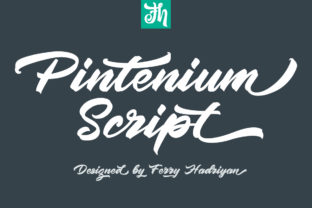
Pintenium: A Charming Script Font with Unique Alternates
Imagine a script font that feels handwritten but polished—fluid enough for a wedding invitation, expressive enough for a boutique logo, and versatile enough to keep your social media posts feeling personal. That’s Pintenium: a carefully crafted script typeface designed with warmth, rhythm, and thoughtful detail. It’s not just decorative—it’s functional. Built with an extensive set of stylistic alternates, ligatures, and contextual substitutions, Pintenium gives you real control over how each word flows, so no two uses feel exactly the same.
Why “Charming” Isn’t Just Marketing Speak
The charm of Pintenium lies in its balance—between elegance and approachability, consistency and variation. Unlike some script fonts that rely heavily on exaggerated swashes or rigid calligraphic rules, Pintenium offers subtle shifts in stroke weight, natural entry/exit terminals, and soft curves that mimic ink on paper without demanding expert lettering skills. Its alternates aren’t gimmicks; they’re practical tools. Swap a single lowercase “a” for one with a higher loop, or choose a “g” with a closed tail instead of an open one—small decisions that add quiet distinction to headlines, quotes, or product labels.
For Beginners & Hobbyists
If you’ve ever opened a design app, typed a word, and thought, *“Why does this look stiff or generic?”*—Pintenium helps bridge that gap. You don’t need to know OpenType features to start. Most design tools (like Canva, Figma, or Adobe Express) automatically apply basic alternates when you enable “stylistic sets.” Try typing “hello” twice: once with default glyphs, once with Set 1 activated—and notice how the second version feels more intentional. That’s low-effort personality. For hobbyists making greeting cards, journal covers, or Instagram story quotes, Pintenium delivers polish without a learning curve.
For Freelancers & Small Business Owners
When you’re juggling client work, brand identity, and tight timelines, flexibility matters. Pintenium supports multiple weights (light, regular, bold), so you can use it across business cards, website headers, and packaging without switching fonts. Its alternates let you create visual hierarchy without adding extra typefaces—e.g., use a swash-heavy “S” for a logo lockup, then switch to simpler forms for body copy in a brochure. One font, multiple tones. That saves time, reduces licensing complexity, and keeps branding cohesive—even if you’re updating assets solo.
For Educators & Content Creators
Teachers designing classroom posters, educators building digital lesson slides, or bloggers illustrating key concepts benefit from fonts that support clarity *and* character. Pintenium’s generous x-height and open counters make it surprisingly legible at medium sizes—unusual for scripts. Pair it with a clean sans-serif for body text, and you get contrast that guides attention without sacrificing warmth. A history teacher might use Pintenium for quote callouts (“As Frederick Douglass wrote…”); a yoga instructor could apply it to workshop titles (“Breathe • Move • Return”)—all while maintaining readability on screens and printed handouts.
For Designers & Brand Professionals
You likely already know what makes a script font technically sound—but Pintenium stands out in execution. Its OpenType features include discretionary ligatures, titling alternates, and even stylistic sets optimized for all-caps settings (rare for scripts). That means you can set a short headline like “SUMMER SALE” in uppercase Pintenium and still preserve rhythm and spacing—no manual kerning marathons required. Plus, its character set covers Latin Extended-A, supporting accented characters used across Spanish, French, Portuguese, and more. That’s practical inclusivity—not just aesthetics.
What People Often Overlook (But Should Consider)
Not every project needs a script font—and not every script font works well in every context. Pintenium shines where human touch matters: invitations, artisan packaging, editorial pull quotes, boutique websites, podcast cover art. It’s less ideal for dense paragraphs, data tables, or interfaces requiring rapid scanning. That’s not a flaw—it’s intentionality. Ask yourself: Is legibility my top priority right now, or is tone? If tone wins, Pintenium earns its place.
Cost and licensing also vary by use. Personal projects often fall under free or low-cost licenses. Commercial use—especially for logos or merchandise—may require a standard or extended license. Always check the source (e.g., Creative Market, MyFonts, or the foundry’s site) for clear terms. No surprises, no assumptions.
Real-World Uses—Simple & Specific
- A blogger uses Pintenium’s light weight for post titles and its bold alternate for featured quote graphics—keeping visual rhythm across platforms without custom illustrations.
- A ceramicist prints Pintenium onto product tags, choosing different “o” alternates for each item (“Mug,” “Bowl,” “Vase”)—adding subtle uniqueness to inventory without redesigning each label.
- A nonprofit organizer applies Pintenium to event posters alongside a neutral sans-serif, creating immediate emotional resonance in fundraising materials—without compromising accessibility.
- A student designer explores OpenType features in Illustrator, toggling between stylistic sets to see how small glyph changes affect perceived formality—turning font study into hands-on typography practice.
Does Pintenium Fit Your Next Project?
It depends—not on your skill level, but on your intent. If you value:
- Creativity with constraints: Pintenium gives structure *and* room to play—no blank-canvas overwhelm.
- Consistent yet distinctive visuals: Its alternates help avoid repetition across social posts, email headers, or product variations.
- Human-centered communication: It signals care, craft, and connection—valuable whether you’re launching a side hustle or teaching a workshop.
But if your work prioritizes ultra-fast readability at small sizes (think app UI or legal disclaimers), or if you need Cyrillic or Arabic support, Pintenium isn’t built for that—and that’s okay. Good tools serve specific purposes well.
Ultimately, Pintenium invites you to slow down a little—to consider how letterforms carry voice, how small typographic choices shape perception, and how accessibility and artistry aren’t opposites. Whether you’re sketching ideas on paper or fine-tuning a vector file, it’s a font that respects both your time and your intention.