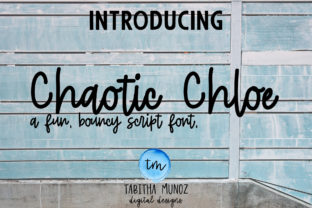
Chaotic Chloe: A Handwritten Script Font with Strategic Magic
Chaotic Chloe isn’t just another playful font—it’s a bouncy, handwritten script designed with intention. Its irregular baseline, uneven letter spacing, and whimsical ligatures create a sense of joyful unpredictability—yet beneath that surface lies real utility. When used thoughtfully, Chaotic Chloe supports human-centered communication, strengthens brand warmth, and invites attention without demanding it. It works best not as decoration, but as a deliberate tool in your visual decision-making toolkit.
Why “Chaotic” Isn’t the Same as “Unplanned”
The word “chaotic” in Chaotic Chloe’s name signals energy—not disorder. Its rhythm mimics natural handwriting: slight variations in stroke weight, subtle tilts, and organic flow. That authenticity resonates with audiences increasingly fatigued by over-polished, algorithm-optimized visuals. For entrepreneurs launching a boutique service, educators designing learning materials, or creators building a personal brand, Chaotic Chloe signals approachability, creativity, and grounded confidence—not perfectionism.
Strategically, this matters because perception shapes action. A customer seeing Chaotic Chloe on a workshop flyer may subconsciously register “this feels human, I can trust it.” A freelancer using it in a pitch deck header signals they value personality alongside professionalism. The font doesn’t replace strategy—it amplifies clarity when aligned with purpose.
Where Chaotic Chloe Delivers Real Value
Chaotic Chloe excels in contexts where emotional resonance and memorability outweigh strict legibility requirements. Think of it as a voice—not the entire conversation. Use it where you want to:
- Anchor key messages: A single headline, tagline, or call-to-action in Chaotic Chloe draws the eye while reinforcing tone—e.g., “Your First Step Starts Here” on a coaching landing page.
- Humanize digital touchpoints: Email subject lines, social media banners, or PDF worksheet headers benefit from its warmth without sacrificing readability at appropriate sizes (24px+ for display, 36px+ for print).
- Differentiate niche positioning: In saturated markets—like mindfulness apps, handmade goods, or independent publishing—Chaotic Chloe helps signal values like authenticity, playfulness, or craft before a word is read.
- Support visual hierarchy: Paired with a clean sans-serif (e.g., Inter, Lato, or Open Sans), Chaotic Chloe creates contrast that guides attention naturally—no extra UI elements needed.
Timing Matters: When to Reach for Chaotic Chloe—and When Not To
Chaotic Chloe shines in moments of invitation—not instruction. It’s ideal for:
- Branded merchandise with emotional appeal (e.g., tote bags, greeting cards, limited-edition zines)
- Workshop or course titles where warmth and accessibility are strategic differentiators
- Blog post headers or newsletter intros that aim to spark curiosity, not convey complex data
- Visual storytelling assets—like quote graphics or behind-the-scenes social posts—that reflect your creative process
It’s less effective—or potentially counterproductive—in:
- Legal disclaimers, pricing tables, or policy pages where clarity, consistency, and scannability are non-negotiable
- Mobile interfaces with small text fields or dense navigation menus
- Brands built on precision, authority, or technical rigor (e.g., cybersecurity firms, financial compliance tools) unless carefully contextualized
- Long-form body copy—its charm fades quickly beyond short bursts of text
Using Chaotic Chloe Intentionally: A Practical Framework
Intentional use starts with asking three questions before applying the font:
- What outcome do I want this element to support? (e.g., “I want visitors to feel welcome enough to click ‘Book a Call’”)
- Who is seeing this—and what assumptions might they bring? (e.g., “My audience includes educators who value creativity but distrust gimmicks”)
- Does Chaotic Chloe reinforce—or distract from—the message’s core meaning?
If the answer to #3 is unclear, test it. Try two versions of a landing page headline: one in Chaotic Chloe, one in your primary brand typeface. Measure scroll depth, time-on-page, or conversion rate—not just preference. Data reveals whether the font serves your goals or merely satisfies an aesthetic impulse.
Also consider pairing discipline. Chaotic Chloe gains credibility through contrast. Use it only where it has breathing room—never crammed beside dense bullet points or competing decorative elements. Give it space, size, and silence. That restraint makes its presence meaningful rather than decorative.
Risks of Using Chaotic Chloe Without Context
Without clear intent, Chaotic Chloe can unintentionally signal inconsistency, informality, or lack of polish—especially to audiences unfamiliar with design nuance. A law firm using it for a client intake form may inadvertently undermine perceptions of reliability. A SaaS dashboard using it for error messages could reduce comprehension under stress. These aren’t flaws in the font—they’re misalignments between tool and context.
More subtly, overuse dilutes impact. If every banner, button, and testimonial uses Chaotic Chloe, it stops feeling special and starts feeling repetitive—or worse, arbitrary. That erodes the very differentiation it was meant to provide.
Another risk is accessibility oversight. While Chaotic Chloe meets basic WCAG contrast standards at larger sizes, its irregular forms may challenge users with dyslexia or low vision in smaller applications. Always pair it with accessible fallbacks and never rely on it alone for critical information.
Strategic Pairing and Practical Implementation Tips
Chaotic Chloe works best when anchored by structure. Here’s how seasoned designers and communicators apply it:
- Limit usage to one primary role per asset: One headline, one logo lockup, one CTA—never more than two distinct applications in a single layout.
- Test color contrast rigorously: Dark charcoal on off-white performs better than black on pure white; avoid light gray text entirely.
- Optimize file delivery: Serve Chaotic Chloe as a modern WOFF2 file with font-display: swap to prevent invisible text during load—critical for performance-sensitive platforms like Shopify or WordPress.
- Consider licensing scope: Ensure your license covers web, app, and print use if you plan cross-channel deployment. Some versions restrict commercial redistribution (e.g., in editable Canva templates).
- Think beyond pixels: If printing physical materials, request a high-resolution OTF version and verify kerning adjustments—digital rendering doesn’t always translate to ink-on-paper fidelity.
Long-Term Positioning: How Chaotic Chloe Fits Into Sustainable Branding
Brands that endure don’t chase trends—they curate tools that reflect evolving values without sacrificing coherence. Chaotic Chloe fits here when treated as part of a broader typographic system—not a standalone flourish. Over time, consistent, thoughtful application builds recognition: your audience begins associating that bounce and tilt with your particular kind of warmth, wit, or wisdom.
That requires patience. Don’t expect immediate ROI from font choice alone. Instead, track how Chaotic Chloe contributes to softer metrics: increased email open rates on subject lines using it, higher engagement on Instagram carousels with its headers, or qualitative feedback like “your materials always feel so inviting.” Those signals compound—quietly, steadily—into differentiated positioning.
Ultimately, Chaotic Chloe is most powerful when it reflects a deeper commitment: to communicating with humanity, not just efficiency. It reminds us that strategy isn’t only about what we say—but how authentically, respectfully, and memorably we say it. Used well, it doesn’t just look magical. It helps make work feel meaningful.