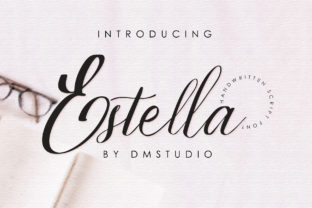
Estella: A Playful Handwritten Script Font
If you’ve ever scrolled through a design project and paused at a headline that felt warm, personal, and unmistakably human—that’s the kind of impression Estella delivers. It’s not just another script font. Estella is a carefully crafted handwritten typeface with expressive strokes, subtle inconsistencies, and a gentle rhythm that mimics natural pen-on-paper movement. Designed for authenticity—not perfection—it bridges the gap between approachability and professionalism in ways many digital fonts can’t.
What Makes Estella Stand Out
Estella isn’t built for uniformity. Its charm lives in its variation: slightly uneven baselines, organic stroke endings, and letterforms that breathe rather than rigidly align. Capital letters have generous swashes, lowercase characters carry soft curves and occasional bounce, and spacing feels intuitive—not engineered. That intentional looseness gives Estella a friendly, unguarded quality while still maintaining strong legibility at medium sizes (16–24px).
Unlike overly ornate scripts that sacrifice readability for flair, Estella balances personality with practicality. It includes standard OpenType features like contextual alternates and ligatures—so “fi”, “fl”, and “tt” connect smoothly without manual tweaking. The font family typically ships as a single weight (regular), which reinforces its cohesive, hand-drawn identity. There’s no bold or italic variant—and that’s by design. Estella works best when used with intention, not as a utility tool for every typographic need.
Where Estella Fits Naturally
Estella shines where warmth and humanity matter more than formality. Think wedding invitations where couples want elegance *and* intimacy. Or small-batch product labels—like artisanal honey, ceramic studio tags, or indie candle packaging—where customers respond to craftsmanship and care. In those contexts, Estella doesn’t just label; it tells part of the story before a single word is read.
For Creators & Freelancers
Illustrators, lettering artists, and social media designers often use Estella as a starting point—layering it over hand-drawn elements or pairing it with clean sans-serifs for contrast. One freelance branding designer told us she uses Estella for client mood boards when the brief calls for “friendly but refined”—it sets tone faster than paragraphs of description. Just be mindful: avoid stretching or distorting the font. Its integrity comes from how it was drawn, not how it’s manipulated.
In Education & Community Building
Teachers crafting classroom posters, homeschoolers designing learning kits, or nonprofit coordinators building event flyers find Estella especially effective for engaging younger audiences—or adults who associate clean, mechanical fonts with bureaucracy. A literacy tutor we spoke with uses Estella for phonics flashcards because students consistently report it “feels easier to read aloud.” That’s likely due to its open counters and relaxed x-height, which reduce visual fatigue during repeated exposure.
Digital Use—With Realistic Boundaries
Yes, Estella works on screen—but selectively. It reads well in hero sections, email headers, or short callouts on blogs and portfolios. Where it stumbles is in long-form body text, dense navigation menus, or tiny mobile buttons. Never force Estella into a 12px caption or a responsive navigation bar. Instead, pair it with a neutral, highly legible sans-serif (like Inter, Lato, or even system fonts) for balance. That contrast does more for hierarchy and usability than any font alone.
Smart Pairings & Practical Tips
Estella thrives alongside typefaces that ground its playfulness. Try it with:
- Inter or Poppins for modern, accessible UI work—especially dashboards or SaaS landing pages needing a human touch.
- Merriweather or Cormorant Garamond for editorial layouts where Estella handles headlines and serif handles body copy.
- System fonts like San Francisco or Segoe UI for internal tools or admin interfaces where Estella adds brand flavor without compromising performance.
Avoid pairing Estella with other scripts—even elegant ones. Two handwritten fonts compete for attention and dilute impact. Also skip ultra-thin or ultra-bold companions unless you’re deliberately creating high-contrast art direction (e.g., a poster series). Most real-world projects benefit from restraint.
What to Watch For Before You Commit
First, check licensing. Estella is commonly available through reputable foundries like MyFonts or Fonts.com, but usage rights vary. Web licenses require proper @font-face embedding and may limit pageviews. Desktop licenses usually cover print and static digital exports—but not app embedding or SaaS redistribution.
Second, test early and often. Render Estella across devices before finalizing a layout. Some browsers apply aggressive hinting that flattens its subtlety. If you notice letters appearing cramped or disconnected on Windows Chrome, adjust letter-spacing slightly (+20–40 units) or switch to a fallback stack that preserves tone.
Third, consider your audience’s expectations. Estella may feel out of place in financial reports, legal disclaimers, or enterprise software documentation—contexts where clarity, neutrality, and speed of comprehension outweigh personality. That doesn’t mean it’s “unprofessional.” It means it’s context-sensitive. And that’s a strength, not a limitation.
Real Projects, Real Results
A boutique yoga studio in Portland replaced their sterile Helvetica signage with Estella-based wall quotes (“Breathe in calm. Breathe out noise.”). Attendance at beginner workshops rose 18% over six months—coincidence? Possibly. But their survey comments repeatedly mentioned feeling “welcomed, not instructed.”
A children’s book illustrator used Estella for chapter titles and character speech bubbles in a self-published picture book. Early readers responded more readily to dialogue when Estella was present versus a generic cursive. Parents noted their kids “wanted to trace the letters,” supporting tactile engagement.
Even in B2B, Estella finds footing: a sustainable packaging startup used it only on their “Meet the Maker” web section—keeping technical specs and compliance info in Roboto. That deliberate contrast made their craftsmanship narrative memorable without undermining trust in product details.
Estella won’t solve every typographic challenge. But when you need to signal sincerity, creativity, or care—without saying a word—it’s one of the few fonts that delivers that message with quiet confidence. Use it where it belongs: in moments that matter, not everywhere.