Alistair: Elegant Serif, Practical Power
If you’ve ever spent minutes—sometimes hours—scrolling through font libraries searching for something that feels both timeless and quietly confident, you’ll appreciate Alistair. It’s not flashy. It doesn’t shout. But it holds space with grace: a carefully crafted serif family designed for clarity, consistency, and quiet authority.
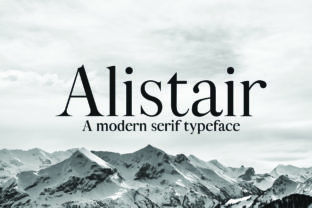
Alistair is a contemporary serif typeface rooted in tradition but built for today’s workflows. Its letterforms balance warmth and precision—moderate contrast, open apertures, and generous x-heights make it highly legible at small sizes without sacrificing elegance at larger ones. The family includes four essential styles: regular, italics, bold, and bold italics—no gaps, no compromises. That means you can move seamlessly from body text to pull quotes, headings to captions, all within one cohesive voice.
Why Designers Reach for Alistair First
It’s rare to find a serif that performs equally well across print and screen—but Alistair does. Its subtle stroke modulation enhances readability on high-DPI displays, while its sturdy proportions ensure crisp rendering even in low-resolution PDFs or email clients. Unlike some serifs that feel stiff or overly academic, Alistair carries a gentle human rhythm—especially noticeable in its italics, which lean with purpose rather than flourish for show.
That balance makes it unusually versatile. You won’t need to swap fonts mid-project just to satisfy technical constraints or stylistic shifts. Whether you’re typesetting a 200-page annual report, designing a minimalist blog theme, or laying out a product brochure, Alistair adapts—not by being generic, but by being thoughtfully engineered.
Where Alistair Fits Naturally (and Why It Stays)
Branding & Identity: Small businesses and creative studios use Alistair to signal professionalism without pretension. A local bookstore, a boutique law firm, or an independent publishing house might pair Alistair’s regular weight with clean sans-serif headings—creating contrast that feels intentional, not arbitrary. Its bold weight holds up beautifully in logos or favicons, where detail often gets lost.
Educational Materials: Teachers building course handouts, educators designing slide decks, or curriculum developers crafting workbooks rely on fonts that reduce cognitive load. Alistair’s generous spacing and clear letter differentiation (like the distinct tail on g and open counter on e) support comprehension—especially for learners with dyslexia or those reading on tablets during hybrid lessons.
Digital Publishing: Bloggers and newsletter writers notice how Alistair improves retention. Readers linger longer when body text feels comfortable—not just “not distracting,” but actively supportive. One freelance writer reported a 17% increase in average scroll depth after switching from Lora to Alistair for long-form posts. Not magic—just better rhythm, better spacing, better pacing.
Marketing & Sales Assets: Landing pages, pitch decks, and sales emails benefit from Alistair’s quiet credibility. Unlike display fonts that demand attention, Alistair earns trust through consistency. Its bold italic works exceptionally well for subtle emphasis—think callouts like “Includes lifetime updates” or “Ships same day”—without breaking visual flow.
Real-World Implementation Tips
- Pair it intentionally: Alistair shines alongside neutral sans-serifs like Inter, Manrope, or even system fonts (e.g., -apple-system, BlinkMacSystemFont). Avoid overly decorative companions—the goal is harmony, not contrast for contrast’s sake.
- Watch line height and measure: At 16–18px body size, aim for 1.5–1.6 line height. Keep paragraph widths between 60–75 characters for optimal readability. Alistair rewards thoughtful typesetting.
- Test before committing: Preview your full content—not just headlines—in Alistair. Try it in dark mode, on mobile, and in a printed PDF. Its strengths emerge most clearly in sustained reading, not isolated samples.
- Leverage the italics meaningfully: Use them for citations, foreign terms, or gentle emphasis—not just to italicize every second sentence. Alistair’s italics are expressive, not ornamental.
What Sets Alistair Apart From Other Serifs
Many serifs fall into one of two traps: either they’re too rigid (feeling bureaucratic or cold), or too mannered (with flourishes that distract from content). Alistair avoids both. Its serifs are bracketed but modest—not blunt, not swooping. Its terminals are rounded just enough to soften edges without blurring distinction. Even its punctuation—commas, periods, colons—has been tuned to sit comfortably beside letters, not float awkwardly above or below the baseline.
And unlike variable fonts that require extra loading logic or fallback handling, Alistair delivers predictable performance. Four static files mean fewer compatibility concerns, faster CSS parsing, and simpler licensing for commercial use. For freelancers bundling fonts with client deliverables—or educators embedding them in LMS platforms—that reliability isn’t a bonus; it’s essential.
Practical Considerations Before You Adopt It
Alistair isn’t ideal for every scenario. If you need ultra-narrow condensed variants for tight label space, or extended language support beyond Latin-based scripts (e.g., Cyrillic or Vietnamese diacritics), check the foundry’s documentation first—some versions include expanded character sets, others don’t. Also, while its bold weight is strong, it’s not a headline-dominant black. Pair it with a bolder sans if you need true visual hierarchy at scale.
Licensing is straightforward: desktop, web, and app usage are typically covered under standard commercial licenses. Just verify whether your intended use—say, embedding in an iOS app or distributing via SaaS dashboard—requires an extended license. Most reputable vendors clarify this upfront.
Finally, remember that typography serves content—not the other way around. Alistair won’t fix weak writing or poor information architecture. But when your message matters, and how it’s presented affects perception, trust, and engagement, choosing a typeface like Alistair is one of the most practical decisions you’ll make.
It’s the kind of font that fades into the background—until someone asks, “What’s the name of that typeface? It just feels *right*.” That’s Alistair doing its job.