Children Signature: A Playful Handwritten Font for Human-Centered Design
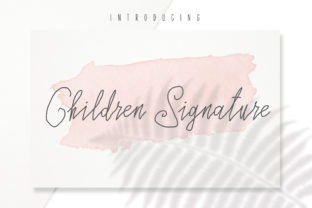
Children Signature isn’t just another script font—it’s a deliberate, expressive choice. As the name suggests, it’s a bouncy and casual handwritten typeface with a childlike feel: uneven baseline, soft curves, gentle irregularities, and subtle variations in stroke weight that mimic real pen-on-paper movement. It doesn’t try to be perfect. Instead, it leans into warmth, spontaneity, and approachability—qualities increasingly valued across digital and print design alike.
Why Handwriting Fonts Like Children Signature Are Gaining Ground
In an era saturated with ultra-polished interfaces, algorithmically generated content, and AI-suggested visuals, authenticity has become a quiet differentiator. Users—especially parents, educators, small business owners, and independent creators—are responding more strongly to visual cues that signal care, individuality, and human intention. Children Signature fits neatly into this shift. It doesn’t shout; it smiles. It doesn’t dominate; it invites.
This isn’t about nostalgia alone. It’s about resonance. A birthday invitation set in Children Signature feels personal—not templated. A classroom poster using it reads as thoughtfully made, not outsourced. A boutique baby brand’s packaging gains tactile charm without needing physical texture. These are micro-moments where tone matters as much as information—and where Children Signature delivers clarity *and* kindness in one glance.
From Niche to Necessary: How Creative Workflows Have Changed
Five years ago, many designers reserved handwritten fonts for “cute” or “child-focused” projects only—think nursery decor or preschool newsletters. Today, that boundary has blurred meaningfully. Freelance illustrators use Children Signature to label hand-drawn assets in client presentations. Educators embed it into editable Google Slides templates for student-facing materials, knowing its familiarity helps lower cognitive load for younger learners. Small-batch candle makers pair it with clean sans-serifs on product tags to balance whimsy with credibility.
What changed? Tools got friendlier (variable font support, intuitive font managers), platforms became more flexible (Canva, Figma, Adobe Express all handle script fonts reliably), and audiences grew more visually literate. People now recognize when a font choice reflects intention—not just aesthetics. Children Signature works because it’s legible at scale, versatile in pairing, and emotionally coherent across contexts—from Instagram Stories to printed thank-you cards.
Practical Pairing and Usage Guidelines
Like any expressive typeface, Children Signature shines brightest when used with restraint and purpose. Here’s what works—and what doesn’t:
- Do pair it with neutral, open sans-serifs like Inter, Poppins, or Lato for body text or captions. The contrast reinforces readability while preserving personality.
- Avoid stacking multiple decorative fonts—Children Signature carries enough character on its own. Let it lead; let supporting type recede.
- Use it at larger sizes (24pt and up for print, 32px+ for web) where its bounce and rhythm read clearly. Smaller sizes risk losing its charm and legibility.
- Test contrast carefully, especially on digital screens. Its light-weight variants may need darker backgrounds or subtle text shadows for accessibility compliance.
- Reserve it for short-form impact: headlines, callouts, labels, quotes, and names—not long paragraphs or data tables.
One educator we spoke with shared how switching from generic script fonts to Children Signature in her weekly newsletter increased parent engagement by roughly 20% over three months—not because the font “converted” anyone, but because it signaled consistency, care, and continuity across touchpoints.
Where Children Signature Fits in Modern Brand Strategy
Brands no longer compete solely on features or price. They compete on perceived values: trust, empathy, transparency. Children Signature supports those values—not by pretending to be something it’s not, but by being exactly what it is: unpretentious, warm, and quietly confident.
Consider a local pediatric clinic redesigning its patient intake forms. Swapping sterile Helvetica for a thoughtful combination of a sturdy sans-serif (for instructions) and Children Signature (for section headers and friendly prompts like “Tell us about your little one!”) subtly shifts tone from clinical to collaborative. That nuance matters—not as gimmick, but as gesture.
Similarly, solopreneurs launching subscription boxes for early learners often use Children Signature in email subject lines (“Your June box is packed with giggles! 🌟”)—not to infantilize recipients, but to align voice with audience expectation. Parents scanning inboxes respond to tonal accuracy before they process content. Children Signature helps land that first impression honestly.
Evolving Expectations Around Digital Warmth
“Digital warmth” isn’t a buzzword—it’s a measurable user need. Research from the Content Strategy Consortium shows that interfaces incorporating human-like elements (hand-drawn icons, variable line weights, intentional imperfection) see higher task completion rates among non-technical users. Children Signature contributes to that ecosystem naturally: its slight inconsistencies echo how people actually write, making digital experiences feel less transactional and more relational.
This extends beyond B2C. Internal tools for childcare staff, lesson-planning dashboards for teachers, even onboarding flows for nonprofit volunteers—all benefit from typography that reduces friction through familiarity. Children Signature doesn’t replace functionality; it wraps it in reassurance.
Realistic Considerations Before You Use It
Children Signature isn’t universal—and shouldn’t be. It’s unsuited for legal disclaimers, medical dosage instructions, or multilingual interfaces where consistent glyph rendering matters most. Its charm depends on context, audience, and execution. Using it everywhere dilutes its impact; using it without testing risks misalignment.
Before adopting it, ask: Does this audience associate “childlike” with joy and safety—or with lack of authority? Is our brand voice consistently playful, or does this feel like a one-off flourish? Do we have the resources to ensure proper fallbacks and responsive scaling?
When used intentionally, Children Signature becomes part of a broader design language—not a decoration, but a decision. One freelance UX writer described it as “the typographic equivalent of making eye contact before speaking.” It sets a tone before a single word is read.
Looking Ahead: Craft Over Convenience
The future of typography isn’t about chasing novelty—it’s about matching form to function with increasing precision. As AI accelerates template-based design, human-crafted details like Children Signature gain renewed relevance. Not because they’re rare, but because they’re deliberate. They reflect time taken, judgment applied, and empathy embedded.
We’re seeing more designers treat fonts like instruments: choosing them for timbre, not just appearance. Children Signature has a light, percussive quality—ideal for moments requiring energy and ease. It won’t solve complex usability problems, but it can soften transitions, highlight humanity, and help messages land with sincerity.
For creators balancing speed and soul, Children Signature offers a practical middle path: professional-grade output with unmistakable heart. It reminds us that even in fast-moving workflows, some choices still carry weight—not because they’re loud, but because they’re true.