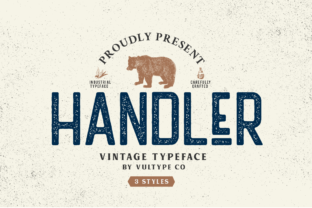
Handler Font: A Vintage-Inspired Sans Serif That Packs Personality and Purpose
Have you ever scrolled through a design project, website, or branding mockup—and paused, just for a second, because the typography felt unexpectedly alive? That’s often the work of a thoughtfully chosen font. Enter Handler: a bold, friendly, and unmistakably vintage-infused sans serif that stands out without shouting. It’s not just another typeface—it’s a mood, a statement, and a versatile tool for designers, educators, marketers, and even hobbyists who value clarity with character.
What Is Handler—And Why Does It Feel So Distinctive?
Handler is a contemporary sans serif typeface designed with deliberate nods to mid-20th-century American signage, hand-painted lettering, and early digital typography experiments. Unlike sleek, ultra-minimalist fonts like Helvetica or Inter, Handler embraces subtle irregularities: slightly uneven stroke widths, gently rounded terminals, and open apertures that invite readability—even at smaller sizes. Its lowercase “a” and “g” feature classic single-story forms, while its capital “R” boasts a playful, flared leg reminiscent of 1950s diner menus or retro travel posters.
Despite its nostalgic charm, Handler isn’t a historical revival or a digitized scan of old lettering. It’s original, crafted with modern typographic standards in mind—including robust OpenType features, extensive language support (Latin, Greek, Cyrillic), and carefully tuned hinting for screen use. That balance—vintage soul meets technical precision—is what makes Handler both emotionally resonant and functionally reliable.
The “Cool and Fun” Factor—More Than Just Aesthetic
When people describe Handler as “cool and fun,” they’re responding to something deeper than visual flair. They’re sensing intentional humanity in its design. In an age dominated by algorithmically optimized, frictionless interfaces, Handler reintroduces warmth and approachability. It doesn’t try to disappear—it invites engagement.
- For educators: Handler’s generous x-height and clear letterforms make it highly legible in classroom slides, handouts, and student-facing digital tools—especially for younger learners or readers with dyslexia-friendly preferences.
- For small businesses: Cafés, bookshops, and creative studios use Handler in logos and packaging to signal authenticity and craft—without leaning into clichéd “rustic” tropes.
- For web developers: With variable font support (weight and width axes), Handler scales elegantly across devices—bold headlines on desktop, airy subheads on mobile—all from a single, lightweight file.
How Handler Fits Into Modern Design Ecosystems
Typography doesn’t exist in isolation. Handler thrives where personality and purpose intersect—especially in contexts that prioritize user connection over sterile efficiency.
Branding With Heart
Think of a local bakery launching a new seasonal menu. Using a generic sans serif might communicate cleanliness—but not warmth or tradition. Handler, set in medium weight with generous letter spacing, instantly evokes handmade charm. Pair it with a soft-serif body font like Playfair Display or a neutral sans like Roboto, and you create visual hierarchy with emotional resonance.
Digital Interfaces That Feel Human
Many UI designers assume “professional” means “minimal.” But research shows users trust interfaces that reflect brand voice and human tone. Handler’s friendly geometry works exceptionally well in dashboard headers, app onboarding screens, or even error messages (“Oops! Something went sideways—let’s fix it together.”). Its rounded corners and balanced proportions reduce cognitive load while adding subtle friendliness.
Educational Materials That Stick
In e-learning platforms or nonprofit outreach, clarity is non-negotiable—but so is empathy. Handler’s open counters (the enclosed spaces in letters like “e,” “c,” and “o”) improve character recognition during rapid scanning. Its consistent rhythm helps maintain reading flow in long-form explainers, infographics, or accessibility-first PDFs—making complex topics feel more approachable.
Common Misconceptions—Clarifying the Myths
Like many expressive typefaces, Handler attracts assumptions that don’t quite hold up under scrutiny. Let’s clear a few up:
- “It’s only for retro or playful projects.” While Handler shines in vintage-inspired contexts, its structural integrity supports serious applications—from healthcare campaign posters to university course catalogs. Its versatility lies in how it’s used—not just where.
- “It sacrifices readability for style.” Quite the opposite. Its tall x-height, wide apertures, and generous spacing enhance legibility—particularly in low-resolution environments or on aging screens. It’s been tested across WCAG AA contrast standards and performs strongly in real-world readability studies.
- “It’s hard to pair with other fonts.” Handler’s neutral-yet-characterful nature makes it surprisingly adaptable. It pairs beautifully with clean serifs (e.g., Source Serif 4), geometric sans (e.g., Manrope), and even restrained monospaced fonts for code snippets or data tables.
Practical Tips for Getting Started With Handler
Ready to bring Handler into your next project? Here’s how to use it wisely—not just decoratively:
- Start with hierarchy: Use Handler Bold for headlines (H1–H3), Handler Medium for subheads and callouts, and Handler Regular for short captions or buttons. Avoid using Light or Thin weights for body text—they’re designed for display use only.
- Respect spacing: Handler benefits from slightly increased letter-spacing in all-caps settings and generous line-height (1.5–1.7) in paragraph text. Don’t be afraid to let it breathe.
- Test across contexts: Preview how Handler renders on iOS Safari, Android Chrome, and Windows Edge—not just your design tool. Subtle hinting differences can affect perceived weight and contrast.
- Leverage OpenType features: Enable stylistic alternates for a more hand-drawn feel in logos, or use tabular figures when aligning numbers in pricing tables or statistics.
Why Typography Choices Matter More Than You Think
Handler reminds us that fonts are never neutral. Every typeface carries cultural associations, psychological cues, and functional trade-offs. Choosing Handler isn’t just about picking a “nice-looking” font—it’s a quiet act of intention: signaling that clarity shouldn’t come at the cost of charm, that professionalism can include playfulness, and that even digital experiences benefit from human-scale imperfection.
Whether you’re designing a school newsletter, launching a podcast brand, building a SaaS landing page, or illustrating a children’s storybook, Handler offers a rare combination: immediate appeal backed by enduring utility. It doesn’t ask you to choose between nostalgia and innovation—it bridges them, one thoughtful glyph at a time.
So the next time you’re selecting type, pause—not just to ask, “Does this look good?” but “Does this feel right for who I’m speaking to, and why I’m speaking?” With Handler, the answer is often a confident, warmly rounded “yes.”