Go Hand: A Handwritten Font That Feels Like a Friendly Nod Across the Room
If you’ve ever typed out a birthday card and thought, “This looks too stiff—like I’m sending an invoice instead of well wishes,” you’re not overthinking it. Tone matters. So does texture. And that’s where Go Hand quietly steps in—not as a flashy trend, but as a practical, warm, and surprisingly smart handwritten font designed for people who care about how their words land.
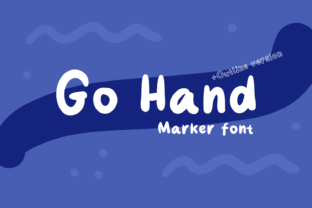
Go Hand isn’t trying to mimic messy scribbles or chaotic chalkboard scrawls. It’s clean, consistent, and carefully spaced—yet unmistakably human. Its lowercase letters have gentle curves and subtle variations, like handwriting done with intention, not haste. Uppercase characters hold presence without shouting. Numbers and punctuation feel like natural extensions of the flow, not afterthoughts. That balance—casual but controlled—is why designers, teachers, small business owners, and even busy parents reach for Go Hand when they want authenticity *without* sacrificing readability or polish.
When You’re Not Just Designing—You’re Connecting
Think about the last time you made a printable habit tracker for your morning routine. Or drafted a welcome email for new coaching clients. Or designed a simple flyer for your neighborhood plant swap. In each case, you weren’t just arranging text—you were setting a mood, building trust, or inviting participation. Go Hand works especially well in those moments because it signals approachability without sounding unprofessional.
A freelance educator might use Go Hand for digital worksheets shared via Google Classroom—students respond more warmly to instructions that look friendly and low-pressure. A café owner updating their Instagram Stories with today’s special? Go Hand makes the chalkboard-style graphic feel handmade, not templated. A wedding planner drafting a soft, elegant timeline for a couple? The font adds intimacy without veering into cutesy territory.
Real Use Cases—Not Just “Nice for Logos”
Let’s get specific—because Go Hand shines brightest when matched to actual needs:
- Email subject lines and headers: Stand out in crowded inboxes without resorting to ALL CAPS or emojis. A subject line like “Your June checklist is ready ✨” set in Go Hand feels personal, not promotional.
- Print-on-demand products: Tote bags, greeting cards, or minimalist wall art benefit from Go Hand’s rhythm—it reads clearly at small sizes and holds charm at large ones.
- Educational handouts: Teachers using Canva or Google Slides can replace sterile sans-serifs with Go Hand for learning objectives or reflection prompts. Students subconsciously register less cognitive load—and more invitation.
- Small business signage: A local pottery studio’s “Open Daily • 10–6” sign gains warmth with Go Hand. It doesn’t scream “artisan”—it quietly embodies it.
- Personal branding assets: Freelancers building a cohesive visual identity often struggle to balance personality and credibility. Go Hand pairs beautifully with neutral sans-serifs (like Inter or Lato) for body text—giving headlines heart while keeping content scannable.
Who Benefits Most—and Why It’s Not Just About Aesthetics
It’s easy to assume handwritten fonts are only for “creative types.” But Go Hand serves practical goals across roles:
A blogger writing about mental wellness might choose Go Hand for pull quotes in newsletter graphics—not to look artsy, but to soften heavy topics and reduce reader defensiveness. A nonprofit coordinator designing a donor thank-you postcard uses it to reinforce sincerity; donors remember how something *felt*, not just what it said. Even a software developer documenting an internal tool might apply Go Hand to onboarding slide headers—making technical onboarding feel less intimidating and more collaborative.
The key is intentionality. Go Hand doesn’t work well for dense paragraphs, legal disclaimers, or data tables—but that’s not its job. It excels where tone carries weight: invitations, affirmations, highlights, calls to pause or reflect. When used this way, it supports communication instead of competing with it.
What to Consider Before You Use Go Hand
Before downloading or licensing Go Hand, ask yourself three things:
- Is legibility non-negotiable in this context? If your audience includes older adults, people with dyslexia, or users viewing on low-resolution screens, test Go Hand at the smallest size you’ll use. It’s clear at 16pt+, but avoid it below 14pt in body copy.
- Does it align with your brand’s voice—or dilute it? A fintech startup using Go Hand for a security alert would unintentionally undercut urgency. But using it for a “Tips for Safer Passwords” checklist? That’s empathetic clarity.
- Do you need language support beyond basic Latin characters? Go Hand covers Western European languages well (including accented characters), but doesn’t include Cyrillic, Greek, or extended diacritics. Check the character map before committing to multilingual projects.
You don’t need design training to use Go Hand effectively. You do need to notice how people react to your materials—and be willing to adjust. Try swapping it in for one headline in your next Canva template. Print a draft of your workshop handout with Go Hand for section titles only. See if participants comment on how “easy” or “inviting” the layout feels—even if they can’t name why.
More Than a Font—A Subtle Shift in How You Show Up
In a world saturated with algorithm-optimized templates and AI-generated visuals, choosing Go Hand is a small act of human-centered design. It says: *I took a moment to consider how this will be received—not just seen.* That intention shows up in quieter ways: longer email open rates, higher engagement on social posts, students completing optional reflection prompts, customers pausing to read your “About Us” page instead of scrolling past.
It won’t fix unclear messaging or poorly structured content. But paired with thoughtful writing and purposeful layout, Go Hand helps ideas land with grace. It’s the difference between handing someone a printed receipt and handing them a note tucked beside it—same information, entirely different resonance.
So whether you’re sketching a concept on paper, building a Shopify banner, or drafting a heartfelt note to a colleague who just had a baby—try Go Hand where warmth matters more than width, and connection matters more than convention. It’s not about looking handmade. It’s about feeling human—on purpose.