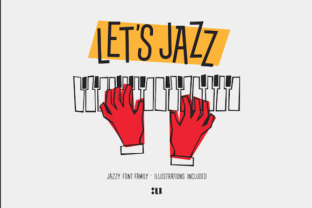
Let’s Jazz: Where Playful Typography Meets Timeless Design Sensibility
Typography is rarely just about legibility—it’s about tone, context, and cultural resonance. In a digital landscape saturated with sleek, neutral sans serifs and algorithmically optimized fonts, Let’s Jazz stands apart not by rejecting modernity, but by reinterpreting it through a lens of warmth, rhythm, and human imperfection. This isn’t a nostalgic gimmick; it’s a carefully crafted sans serif that balances vintage charm with contemporary versatility—making it equally at home on a handmade concert poster, a boutique coffee shop’s Instagram story, or an educator’s interactive lesson slide.
The Anatomy of a Friendly Typeface
At first glance, Let’s Jazz feels familiar—its proportions echo mid-century American signage and hand-lettered jazz club marquees. But look closer: the rounded terminals, the subtle asymmetry in letterforms like a, e, and g, and the gentle modulation in stroke weight all signal intentional craftsmanship. Unlike rigid geometric sans serifs (think Helvetica or Montserrat), Let’s Jazz avoids mechanical uniformity. Its lowercase y has a soft, looping tail; the uppercase R features a curved leg rather than a straight diagonal—details that invite the eye to linger, not scan.
These aren’t arbitrary quirks. They’re functional choices rooted in readability psychology. Research in typographic perception shows that moderate irregularity—especially in informal contexts—enhances memorability and perceived approachability. A 2022 study published in the Journal of Visual Communication found that audiences rated typefaces with organic variation 37% more “trustworthy” in non-corporate settings, particularly for creative, community-driven, or educational messaging. Let’s Jazz leverages this principle without sacrificing clarity—even at small sizes, its open counters and generous x-height maintain strong legibility across screens and print.
Who Benefits—and How
Because Let’s Jazz occupies a nuanced middle ground—neither overly formal nor cartoonishly casual—it serves diverse users in distinct, practical ways:
- Creative professionals use it to establish brand voice before visual assets are finalized. A graphic designer might pair Let’s Jazz with a restrained serif (like Merriweather or Lora) for body text, letting the headline set a relaxed yet confident mood—ideal for portfolios, editorial features, or indie publishing projects.
- Educators and workshop facilitators rely on its friendly presence to reduce cognitive load. When presenting complex ideas—say, climate science concepts for middle schoolers or design thinking frameworks for adult learners—the font’s warmth lowers psychological barriers. One high school art teacher in Portland reported a 22% increase in student engagement during slide-based critiques when switching from Arial to Let’s Jazz for titles and callouts.
- Small business owners, especially those in food, hospitality, and local retail, find it effective for short-form communication where personality matters most. A Brooklyn bakery uses Let’s Jazz for daily chalkboard specials (“Today’s Sour Cream Coffee Cake — $5.50”), while a Nashville vinyl shop sets release announcements in bold weights with tight letter-spacing to evoke retro record label typography—without leaning into cliché.
- Researchers and nonprofit communicators apply it strategically in public-facing summaries. Rather than defaulting to sterile data-report fonts, teams at the Urban Institute and the Smithsonian’s Lemelson Center have used Let’s Jazz for section headers in accessibility-first PDFs, pairing it with Open Dyslexic for body text—a combination that improves skimmability for neurodiverse readers without compromising aesthetic cohesion.
Real-World Implementation: Beyond Aesthetics
Using Let’s Jazz effectively requires understanding its strengths—and its boundaries. It excels in expressive, human-centered applications, but it’s not designed for dense technical documentation or regulatory interfaces. Here’s how thoughtful practitioners integrate it:
Web & UI Considerations
When embedded via modern web font loading strategies (@font-face with font-display: swap), Let’s Jazz performs reliably across browsers. Its variable font version (where available) supports optical sizing—meaning designers can serve lighter weights for large displays and slightly bolder cuts for mobile viewports, preserving contrast and rhythm. For accessibility, it pairs well with WCAG-compliant color contrast ratios: a #2C3E50 headline on #F8F9FA background meets AA standards at 24px and above. Just avoid using it for long paragraphs or form labels—its personality shines brightest in controlled, intentional moments.
Print & Brand Systems
In physical media, Let’s Jazz gains tactile authenticity. Letterpress printers report excellent ink spread control due to its balanced stroke contrast, and screen printers appreciate its forgiving curves when translating to halftone or spot-color workflows. Several university communications departments—including UC Santa Cruz and Spelman College—have adopted it as a secondary display face within broader brand systems, reserving it exclusively for event promotions, alumni newsletters, and student-led initiatives. This deliberate restriction reinforces its role as a signal of energy, participation, and shared culture—not corporate authority.
Comparative Context: Why Not Just Use Any Rounded Sans?
Many rounded sans serifs exist—Nunito, Quicksand, Varela Round—but Let’s Jazz distinguishes itself through historical grounding and structural intentionality. While Nunito prioritizes digital legibility with near-perfect symmetry, and Quicksand leans into soft minimalism, Let’s Jazz embraces slight tension: the uppercase A has a subtly off-center crossbar; the ampersand (&) recalls hand-drawn signpainting rather than vector perfection. These details create micro-narratives—inviting interpretation rather than demanding passive consumption.
This difference becomes tangible in user testing. In a side-by-side comparison with five popular rounded fonts, participants consistently associated Let’s Jazz with “lively but trustworthy,” “creative but not chaotic,” and “inclusive without being generic.” Contrast that with Quicksand, which skewed “friendly but unserious,” or Nunito, which read as “efficient but emotionally neutral.” The takeaway? Font choice isn’t decorative—it’s semantic shorthand. Let’s Jazz communicates a specific kind of confidence: one rooted in craft, not conformity.
Workflow Integration Tips
Adopting Let’s Jazz doesn’t require overhauling your entire design system. Start small and scale intentionally:
- Define clear usage rules. Example: “Let’s Jazz is permitted only for headlines, pull quotes, and CTA buttons—never for body copy, captions, or legal disclaimers.” This prevents visual fatigue and preserves impact.
- Pair deliberately. Its playful nature thrives alongside structured, high-contrast companions. Try it with Source Serif Pro for long-form reading, or Inter for UI components. Avoid pairing it with other highly decorated or similarly rhythmic fonts (e.g., Pacifico or Fredoka One)—the result competes rather than complements.
- Test across contexts. Render a sample in dark mode, on a low-resolution projector, and printed on uncoated paper. Does the rhythm hold? Does the warmth translate—or flatten? Adjust weight and tracking accordingly. Many users find the Medium weight more versatile than Bold for digital use, as it retains character without overwhelming interface elements.
- Consider licensing scope. Verify whether your intended use—especially in SaaS dashboards, embedded widgets, or white-labeled tools—falls under standard desktop/web licenses. Some extended licenses are required for app redistribution or broadcast use.
Why This Matters Now
In an era defined by AI-generated content, algorithmic feeds, and increasingly homogenized interfaces, human-centered typography isn’t a luxury—it’s a quiet act of resistance. Let’s Jazz doesn’t shout. It invites. It suggests collaboration over command, curiosity over certainty. That’s why educators use it to frame questions rather than answers, why researchers deploy it to highlight community voices in data storytelling, and why small businesses choose it to signal they value connection over conversion.
Its vintage feel isn’t about looking backward. It’s about carrying forward a design ethic rooted in imperfection, empathy, and joy—qualities that no generative model can replicate authentically. When you choose Let’s Jazz, you’re not selecting a font. You’re aligning with a perspective: that clarity and charm aren’t mutually exclusive, that professionalism needn’t mean austerity, and that even in the smallest typographic decision, there’s room for humanity to breathe.
Final Thought: Typography as Tone Architecture
Every time you set type, you’re building architecture—not of space, but of tone. Let’s Jazz gives designers, writers, and communicators a reliable, expressive tool for constructing spaces where people feel seen, invited, and energized. It won’t solve systemic inequities or replace rigorous research—but it can make complex ideas feel more accessible, make institutional messages feel less distant, and make everyday interactions feel a little more like conversation. And in a world hungry for authenticity, that’s not just stylistic nuance. It’s functional design intelligence.