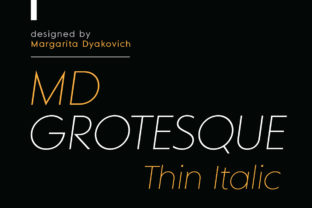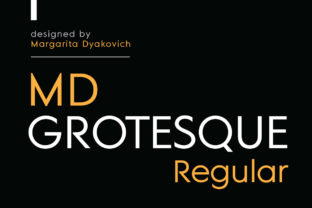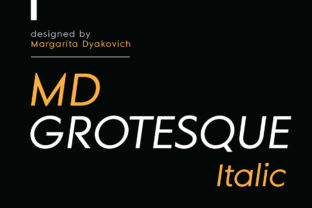
MD Grotesque Italic: Minimalist Clarity, Timeless Voice
When a font feels both quietly confident and effortlessly legible, it’s doing more than holding space—it’s shaping tone, guiding attention, and reinforcing intent. MD Grotesque Italic is one of those rare typefaces that balances restraint with character: a minimalist sans serif built on clean geometry, yet softened by subtle humanist details in its italic form—gentle curves, open apertures, and a natural rhythm that avoids mechanical rigidity.
It’s not flashy. It doesn’t rely on novelty or ornamentation. Instead, MD Grotesque Italic earns trust through consistency, proportion, and quiet authority—qualities that resonate deeply with creators who value clarity over clutter and timelessness over trend-chasing.
Why Designers Reach for This Italic First
Unlike many grotesques that flatten into uniformity when italicized, MD Grotesque Italic retains expressive nuance. Its slant is purposeful—not exaggerated for drama, but angled just enough to signal emphasis, movement, or distinction without sacrificing readability at small sizes or on screen.
This makes it especially useful where hierarchy matters but space is limited: captions beneath editorial photos, pull quotes in long-form blog posts, labels in data dashboards, or even subtle watermark text in presentations. Because it’s designed as part of a cohesive family (with matching weights and widths), switching between roman and italic feels like shifting voice—not changing language.
Creative Applications That Feel Intentional, Not Decorative
Here’s where MD Grotesque Italic moves beyond “just another font” and becomes a tool for thoughtful communication:
- Editorial identity: Pair the regular weight for body text with the italic for subheads, citations, or introductory lines—creating visual breathing room without introducing a second typeface.
- Brand voice refinement: For startups, studios, or educators building a calm, credible presence, using MD Grotesque Italic in headlines or logo lockups signals sophistication without pretension—think science communicators, sustainable product brands, or independent course creators.
- Digital interface microcopy: Buttons labeled “Learn more →”, tooltip hints, or form field instructions gain quiet emphasis when set in italic—guiding users without shouting.
- Print collateral with longevity: Business cards, letterhead, or annual report excerpts benefit from its even color and balanced spacing—no awkward gaps or cramped letters, even in tight columns or narrow margins.
The key isn’t using it everywhere—it’s using it where meaning shifts. Italic shouldn’t be decorative punctuation; it should signal intention. MD Grotesque Italic supports that discipline because it doesn’t distract from the message—it clarifies it.
Adapting Across Audiences and Formats
How you apply MD Grotesque Italic depends less on what you’re making and more on who you’re speaking to—and how much cognitive load they can carry.
For educators and course designers: Use the italic sparingly in slide decks to highlight definitions, core principles, or reflective prompts (“What would happen if…?”). Its openness improves scannability for learners reviewing materials later.
For marketers and small business owners: Try it in email subject lines (where supported) or social media bios—not as a gimmick, but to differentiate your tagline or value proposition from generic copy. Example: “Built for makers. Designed to last.” The contrast feels grounded, not salesy.
For developers and technical writers: In documentation or API references, italicize parameter names (user_id) or status values (pending) while keeping code blocks monospaced. MD Grotesque Italic’s generous x-height and clear letterforms reduce ambiguity—especially important when readers skim for specifics.
Keeping It Effective—Not Just Aesthetic
Even strong tools can weaken impact if misapplied. Here are practical checks to keep your use of MD Grotesque Italic clear and audience-friendly:
- Limit italic usage to two roles per project: e.g., emphasis + attribution, or headings + captions. More than that blurs hierarchy.
- Test contrast at real sizes: On mobile, 14px italic may lose legibility if line height isn’t adjusted. Increase line height by 10–15% when setting italic at smaller sizes.
- Avoid mixing with overly decorative fonts: Its strength lies in contrast with simplicity. Pair it with a neutral sans (like its own roman) or a restrained serif—not script or display faces.
- Check licensing early: While many versions support web use, verify permissions for print runs, app embedding, or client deliverables—especially if you’re a freelancer bundling assets.
Consistency matters more than variety. If you choose MD Grotesque Italic for pull quotes in a magazine layout, use the same weight, tracking, and vertical rhythm each time—even across issues. That repetition builds recognition, not fatigue.
Ideas You Can Start With Today
You don’t need a full rebrand to explore what MD Grotesque Italic offers. Try one of these low-lift, high-impact experiments:
- Redesign your email signature: Switch your name to MD Grotesque Italic, keep your title in the regular weight, and add a single-line descriptor in the same font (“Helping teams write with clarity”).
- Refresh a landing page headline: Replace a bold, condensed sans with MD Grotesque Italic in medium weight—then adjust letter-spacing to +20 for air and elegance.
- Create a simple content template for your team: Define one italic use case (e.g., “All interview quotes go in MD Grotesque Italic, 16px, 1.4 line height”) and share it as a Figma or Google Docs style guide snippet.
- Use it in your next presentation deck for transition slides: “What’s Next”, “Key Takeaway”, or “Let’s Begin”—set in large, centered MD Grotesque Italic with generous margins. The calmness invites focus, not distraction.
None of these require new software or steep learning curves. They rely on intention—not invention.
MD Grotesque Italic works because it asks little of the reader and delivers much: legibility at a glance, tonal warmth without flourish, and flexibility without compromise. It won’t solve every design problem—but when clarity, credibility, and quiet confidence matter most, it’s often the first typeface worth trying.