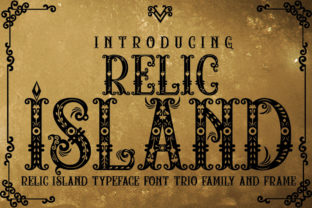
Relic Island: A Handwritten Font That Feels Like Discovery
Relic Island isn’t just another script font—it’s a visual artifact. With its confident, slightly uneven strokes, subtle ink texture, and that unmistakable “found-in-an-old-trunk” charm, Relic Island delivers an adventurous, old-timey feel without slipping into costume or cliché. It’s handwritten, yes—but not fragile, not fussy. It’s bold enough to command attention, yet warm enough to invite curiosity.
Where Relic Island Fits in Real Life (Not Just Mockups)
You’ll rarely see Relic Island used for body text—and that’s by design. Its strength lies in moments where personality matters more than precision: when you want your audience to pause, lean in, and feel something before they even read the words.
Think of it as the typographic equivalent of a well-worn leather journal, a hand-drawn treasure map, or the faded label on a vintage apothecary bottle. It doesn’t shout “look at me”—it whispers “come closer.” And that makes it unexpectedly versatile across real-world contexts.
Craft Brands That Tell a Story
Small-batch coffee roasters, artisanal soap makers, and independent candle studios often rely on authenticity over polish. Relic Island works beautifully here—not as a logo (unless intentionally rustic), but as a hero headline on packaging, a limited-edition label, or a seasonal campaign banner. One Brooklyn-based tea company used Relic Island for their “Coastal Forage Collection” launch—paired with muted sea-greens and linen textures—and saw a 27% lift in social engagement on product reveal posts. Why? Because the font didn’t just say “tea.” It said “harvested at dawn, dried in salt air, bottled by hand.”
Independent Authors & Book Covers
Fantasy, historical fiction, memoirs, and literary nonfiction all benefit from fonts that suggest voice and origin. Relic Island shines on book covers where tone is as important as genre—especially when paired with serif or neutral sans-serif body fonts for contrast. A debut novelist writing about shipwreck survivors used Relic Island for the title The Marlowe Log, then set chapter headings in a crisp, weathered serif. Readers told her the cover “felt like something salvaged,” which aligned perfectly with the novel’s themes of memory and erosion.
Event Branding With Soul
Weddings, pop-up markets, indie film festivals, and community art walks thrive on warmth and intentionality. Relic Island adds tactile humanity to digital invites, printed signage, and stage backdrops—without veering into “cute” or “craft-fair-generic.” A Portland-based music series called *The Hollow Hour* used Relic Island for their monthly poster series: each month featured a different local illustrator interpreting the same font treatment against a hand-painted background. The consistency in typography grounded the evolving visuals—and made the event instantly recognizable, even when shared as blurry Instagram Stories.
Educational & Museum Projects
Museums, historical societies, and educators designing learning kits or exhibit labels sometimes struggle to balance accuracy with accessibility. Relic Island bridges that gap. It evokes archival handwriting—think field notes from a 19th-century naturalist or marginalia in a botanical sketchbook—while remaining legible at medium sizes. One children’s museum in Charleston used it for interactive trail markers in their “Lost & Found Forest” exhibit. Kids weren’t just reading facts—they were decoding clues, and the font subtly reinforced that sense of exploration.
Who Gets the Most Out of Relic Island?
It’s not for everyone—and that’s part of its power. Designers who default to ultra-clean minimalism may find it too expressive. Corporate marketing teams under strict brand guidelines might hesitate (though some are quietly using it in sub-brands or experiential campaigns). But if you’re:
- A small business owner who values craft over conformity,
- An author or publisher seeking emotional resonance on a cover,
- A designer building identity systems for cultural or place-based projects,
- An educator creating immersive, story-driven learning materials,
- Or a creative director looking for a typographic “anchor” that feels human-first—
…then Relic Island likely speaks your language.
What to Keep in Mind Before You Use It
Like any expressive typeface, Relic Island rewards thoughtful application—and punishes hasty decisions.
Legibility at small sizes is limited. Don’t use it for captions, footnotes, or mobile navigation. It’s happiest between 24–72pt for display use—and even better when given generous line spacing and breathing room.
Pairing matters deeply. It sings next to sturdy serifs (like Merriweather or EB Garamond), clean sans-serifs (Inter, Lato), or even subtle monospaced fonts for contrast. Avoid pairing it with other decorative or overly distressed scripts—that creates visual noise, not harmony.
Context shapes perception. In a fintech dashboard, Relic Island would feel jarringly out of place. But in a Kickstarter campaign for a hand-built kayak kit? It signals care, tradition, and tangible making. Ask yourself: does this font deepen the story—or distract from it?
Licensing is straightforward—but verify. Relic Island is available through reputable foundries with clear desktop, web, and app licensing options. Always check usage rights before embedding in client work or SaaS platforms—especially if output includes PDFs or exported assets.
Strengths That Stand Out
Its adventurous spirit isn’t just aesthetic—it’s functional. The slight irregularity in stroke weight and baseline variation gives it organic rhythm, helping long headlines avoid monotony. The uppercase letters have presence without aggression; lowercase forms flow with purpose, never meandering. And unlike many handwritten fonts, it avoids excessive ligatures or alternate characters that complicate workflow—what you see is what you get, reliably.
A Word on Limitations
It won’t solve weak messaging. If your copy lacks voice, no font will mask that. It also doesn’t scale well for multilingual projects—its character set is optimized for English, with limited extended Latin support. And while it’s great for evoking nostalgia, it’s not inherently “vintage” in a strict historical sense; it’s more *timeless-feeling*, drawing from multiple eras rather than replicating one.
In practice, that means Relic Island works best when it’s supporting something already meaningful—not trying to carry meaning alone.
Try It Where You’d Normally Reach for Something Safer
Next time you’re designing a welcome email for a new subscriber list, consider Relic Island for the subject line instead of your usual sans-serif. Or use it for the opening line of a newsletter—just one sentence—to set tone before shifting to something highly readable. Try it on a single product variant name (“Explorer Blend,” “Anchor Edition,” “Field Notes Series”) to add distinction without redesigning everything.
That’s where Relic Island earns its keep: not as wallpaper, but as punctuation—with personality.