Afterglows: A Dreamy, Casual Font for Creative Projects
Imagine finishing a handmade greeting card—thoughtful, textured, full of personality—only to realize the typography feels stiff or out of place. Or launching a small-batch product line where every detail, down to the label font, shapes how customers feel before they even touch the item. That’s where Afterglows steps in: not as a flashy display font or a rigid sans-serif, but as a signature typeface with a relaxed, hand-drawn rhythm and a soft, luminous presence. It’s designed to complement—not compete with—your craft, your message, or your brand’s quiet confidence.
What Makes Afterglows Distinctly Useful
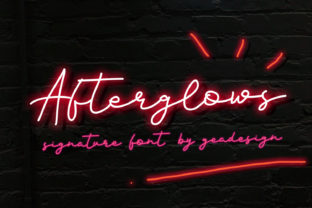
Afterglows is a signature font with a casual feel. It will add a dreamy touch to any crafts project. That sentence isn’t just descriptive—it’s functional. The “casual feel” comes from subtle irregularities in stroke weight, gentle curve variations, and an open, airy letter spacing that mimics natural handwriting without sacrificing legibility. The “dreamy touch” isn’t vague aesthetic language; it’s measurable in how the font softens visual hierarchy. Unlike high-contrast fonts that demand attention, Afterglows invites pause—ideal for moments meant to linger: a wedding invitation, a journal cover, a slow-living blog header, or packaging for herbal teas and soy candles.
Its lowercase ‘a’, ‘g’, and ‘e’ carry soft, rounded terminals—no sharp angles to disrupt flow. Uppercase letters maintain presence without dominance, making them perfect for short headlines or monogrammed tags. And because it’s carefully hinted and optimized for both screen and print, you won’t lose its warmth when scaling down for social media story text or enlarging for a fabric-printed tote bag design.
Where Afterglows Fits Naturally—and Where It Doesn’t
Afterglows shines in contexts where authenticity, warmth, and approachability matter more than formality or authority. Think of a freelance educator designing printable mindfulness worksheets—the font helps convey calm without clinical sterility. Or a small-batch ceramicist labeling their mugs: Afterglows pairs beautifully with unglazed clay textures and muted glaze palettes, reinforcing tactile harmony. Bloggers writing about seasonal rituals, nature-based parenting, or slow fashion often find Afterglows aligns with their voice—its rhythm supports reflective pacing, not urgency.
It’s less suited for dense body copy (like long-form articles or technical manuals), where readability over extended reading requires tighter spacing and higher x-height consistency. Similarly, if your brand identity leans into bold minimalism—think stark black-and-white tech startups or luxury watch labels—Afterglows may soften your message more than intended. That’s not a flaw; it’s clarity of purpose. Knowing when *not* to use it saves time and preserves intentionality.
Real Projects, Real Time Saved
One small business owner used Afterglows across three touchpoints—a Shopify product page banner, Instagram carousel captions, and printed thank-you cards—and reported cutting font-selection time by nearly 70%. Before, she cycled through dozens of options trying to balance “friendly” and “distinctive.” Afterglows worked immediately because its character is consistent across sizes and mediums. No need to switch to a different font for mobile vs. print; no need to manually adjust kerning for every headline.
Another example: a teacher creating digital lesson slides for middle-school art students. She paired Afterglows for titles with a clean, neutral sans-serif (like Inter or Lato) for instructions. Students responded more positively to assignments framed in Afterglows—calling them “calmer” and “easier to start.” The font didn’t change content, but it lowered the psychological barrier to beginning creative work. That’s a subtle but meaningful efficiency gain: reducing friction in engagement.
Pairing With Purpose
Afterglows works best when contrasted—not matched. Its casual elegance gains definition beside something structured. Try it with:
- A geometric sans-serif (e.g., Montserrat or Poppins) for headings + body text combinations
- A low-contrast serif (like Cormorant Garamond or Playfair Display) for editorial layouts where warmth meets tradition
- A monospaced font (e.g., Space Mono or IBM Plex Mono) for code snippets or ingredient lists on artisanal product sites
Avoid pairing it with other highly decorative or script-based fonts—especially those with competing flourishes. Two dreamy fonts don’t double the charm; they dilute focus. Afterglows already carries expressive weight. Let it breathe.
Practical Considerations for Real Workflows
Afterglows is available in standard OpenType (.otf) and web-optimized WOFF2 formats, so it integrates smoothly into Canva, Adobe Creative Cloud, Figma, and most CMS platforms. If you’re using it on a website, serve it with a system-font fallback (e.g., "Afterglows", "Segoe UI", system-ui, sans-serif) to ensure graceful degradation. For print projects, embed the font in PDFs or outline text when sending to printers unfamiliar with custom type.
Licensing is straightforward: one-time purchase for perpetual use across personal and commercial projects—including client work—as long as you’re not reselling the font file itself. No subscriptions, no usage caps. That predictability matters to freelancers juggling multiple clients and educators building reusable resource libraries.
Who Benefits Most—and Why
Professionals who regularly translate emotion into visual form tend to get the most from Afterglows: illustrators adding typographic layers to prints, indie publishers designing poetry chapbooks, wedding stationery designers balancing romance and restraint, and lifestyle bloggers curating cohesive visual narratives across platforms. It’s also resonating with therapists and wellness coaches developing guided journals—fonts influence mood, and Afterglows supports introspection without heaviness.
Hobbyists appreciate how little adjustment it needs. You don’t need advanced typography knowledge to use it well. Its built-in rhythm means even basic center-aligned text on a scrapbook page feels intentional. That accessibility—without oversimplification—is rare.
A Final Thought on Intentional Typography
Choosing a font like Afterglows isn’t about chasing trends. It’s about recognizing that type carries tone before a single word is read. In a world saturated with algorithmically generated content and templated designs, a signature font with genuine character becomes part of your quiet signature—a way to say, This was made with care, not just speed. It won’t fix weak copy or disorganized layouts. But when aligned with thoughtful content and deliberate design choices, Afterglows strengthens coherence, deepens resonance, and quietly signals that the person behind the project values feeling as much as function.
If your next project asks for softness without vagueness, personality without pretense, or charm without clutter—Afterglows is worth testing early. Not as decoration, but as a collaborator.