Maudy Audy Font: A Practical Evaluation for Designers
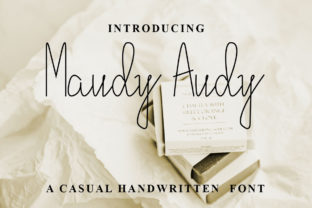
Maudy Audy is a handwritten display font designed to evoke warmth, approachability, and subtle personality. It features flowing, connected letterforms with gentle variations in stroke weight and rhythm—characteristics typical of natural penmanship. Unlike many script fonts that prioritize ornate flourishes or dramatic contrast, Maudy Audy balances legibility with authenticity, offering a “cool twist” through its relaxed spacing and slight irregularities that avoid mechanical uniformity.
Designers often seek handwritten fonts when aiming to communicate friendliness, creativity, or personal connection—whether for branding a boutique business, designing wedding stationery, crafting social media graphics, or adding character to packaging. Maudy Audy fits within this category, but its value lies not in novelty alone; rather, in how its specific qualities align—or don’t align—with functional and aesthetic goals.
Why Consider Maudy Audy?
Readers evaluating Maudy Audy typically do so for one or more of these practical reasons:
- Emotional resonance: Its soft curves and organic movement support designs intended to feel human, unhurried, or intimate—such as lifestyle blogs, artisanal product labels, or wellness-related visuals.
- Distinctiveness without distraction: Compared to highly decorative scripts, Maudy Audy avoids excessive swashes or tight ligatures, making it easier to read at moderate sizes while still standing apart from generic sans-serif or serif options.
- Compatibility with minimalist layouts: Its simplicity allows it to complement clean backgrounds, ample whitespace, and restrained color palettes without overwhelming the composition.
These traits make Maudy Audy especially relevant for projects where tone matters as much as typography—where the font contributes meaningfully to perceived brand voice.
Key Benefits and Realistic Tradeoffs
Among its strengths, Maudy Audy offers consistent baseline alignment and relatively even x-heights across characters, supporting readability in short-form applications like headlines, logos, or callouts. Its OpenType features (if available in the licensed version) may include alternate glyphs and contextual substitutions, giving designers some flexibility in fine-tuning appearance.
However, several considerations affect usability:
- Legibility at small sizes: Like most handwritten fonts, Maudy Audy loses clarity below ~16–18px. It is unsuitable for body text, captions, or interface elements requiring sustained reading.
- Limited language support: Standard releases typically cover Latin-based alphabets (English, Spanish, French, etc.) but may lack extended diacritics, Cyrillic, or Asian character sets—important for multilingual projects.
- Weight and width options: Maudy Audy is generally distributed as a single weight and width. Users needing bold variants, italics, or condensed alternatives must pair it intentionally with complementary typefaces—a common requirement in responsive or hierarchical design systems.
These limitations are not flaws, but inherent constraints of its category. Evaluating Maudy Audy requires matching its capabilities to the scope and context of your project—not assuming it functions like a versatile system font.
When Maudy Audy Is a Strong Fit
Maudy Audy works best in controlled, intentional applications. Examples include:
- A logo for a handmade soap brand emphasizing natural ingredients and personal care;
- Invitation suite typography where elegance and warmth coexist without formality;
- Social media banners or Instagram story text overlays targeting audiences aged 25–40 who respond to authentic, non-corporate aesthetics;
- Editorial accents in print or digital magazines covering topics like mindfulness, slow living, or creative entrepreneurship.
In each case, the font serves a defined role—enhancing mood rather than carrying structural information. Success depends less on technical perfection and more on whether its expressive qualities reinforce the message.
When Alternatives May Be More Appropriate
Consider other options if your project demands:
- Functional versatility: For websites or apps requiring both headings and paragraph text, pairing a readable sans-serif (e.g., Inter, Lato, or Manrope) with a subtle script accent may yield better usability than relying solely on Maudy Audy.
- High-contrast environments: In signage, outdoor advertising, or low-resolution displays, bolder, more geometric scripts—or even rounded sans-serifs—often perform more reliably than delicate handwritten forms.
- Brand scalability: If your visual identity will appear across diverse touchpoints (from mobile notifications to trade show banners), a type system with multiple weights, widths, and optical sizes provides greater consistency than a single-display font.
- Accessibility compliance: WCAG guidelines emphasize contrast, size, and predictability. While Maudy Audy can meet contrast requirements, its variable stroke widths and connected letters may reduce scannability for users with dyslexia or low vision—making fallback fonts essential in accessible implementations.
Making an Informed Decision
To determine whether Maudy Audy suits your needs, begin by clarifying two things: what role does typography play in this project? and what level of control do you have over context?
If typography primarily conveys tone—and you’re working within a bounded, high-fidelity environment (e.g., a printed brochure, a hero section on a desktop-optimized landing page)—Maudy Audy’s expressive qualities can be an asset. Test it with real content: set your actual headline, adjust tracking and size, and view it alongside supporting type. Does it invite attention without competing? Does it reflect the intended feeling without seeming arbitrary?
If, however, your use case involves dynamic rendering (e.g., user-generated content, CMS-driven templates, or multilingual output), prioritize fonts with broader encoding, robust hinting, and documented accessibility testing. Similarly, if your team lacks typographic expertise or time for careful pairing and hierarchy planning, starting with a flexible, well-documented type family may reduce iteration time and improve long-term maintainability.
Finally, licensing matters. Verify whether the version of Maudy Audy you intend to use permits web embedding, commercial redistribution, or modification—especially if integrating into SaaS products or client deliverables. Some free versions restrict usage scope or require attribution, which may conflict with brand guidelines or deployment requirements.
Maudy Audy is neither universally ideal nor inherently limited—it is a tool shaped by specific design intentions. Its usefulness emerges not from broad applicability, but from thoughtful alignment between its characteristics and your project’s functional, aesthetic, and operational constraints. Evaluating it objectively means asking not “Is it beautiful?” but “Does it serve this purpose, here, for these people, under these conditions?” That question, answered honestly, leads to more effective and sustainable typographic choices.