Silly Gal: A Messy, Joyful Display Font
If you’ve ever stared at a design and thought, “It’s technically fine—but where’s the personality?”, Silly Gal might be the quiet nudge your project needs. It’s not a workhorse font built for body text or spreadsheets. It’s a premium display font with a wink, a stumble, and a grin—designed to stand out, not blend in.
What Makes Silly Gal Feel So… Silly?
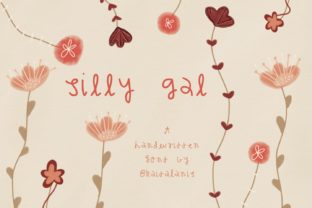
Silly Gal is a handmade-style display font that leans into imperfection. Its letters wobble slightly on the baseline, stroke weights shift unpredictably, and some characters even overlap or trail off like a quick sketch. There’s no rigid grid holding it together—and that’s the point. It’s a sans serif font in structure, but its energy comes from its script-like looseness and irregular rhythm. Think of it as the typographic equivalent of a joyful doodle in the margin of a notebook: unpolished, expressive, and full of character.
It’s not chaotic—it’s intentionally uneven. The lowercase g has a loop that dips low and curls back; the a opens wide and asymmetrical; the y drags a playful tail. Uppercase letters keep that same off-kilter charm, making Silly Gal equally effective for short headlines, logos, or single-word emphasis. It includes one weight (regular) with standard Latin characters, numerals, and basic punctuation—no italics or bold variants, because its voice doesn’t need them. Its strength lies in singular presence, not versatility across styles.
Where Silly Gal Earns Its Keep
This font thrives where authenticity and approachability matter more than formality. In branding, it works beautifully for small-batch food labels, indie book covers, or craft studio logos—places where “handmade” isn’t just a descriptor but a value. A bakery named *Dough & Daydreams*? Silly Gal on a kraft paper bag feels warm and human. A zine about urban gardening? Its irregularity mirrors the messy joy of soil under fingernails and seedlings pushing through concrete.
In editorial design, it shines in section headers, pull quotes, or title pages—not body copy. You wouldn’t set a 2,000-word essay in Silly Gal, but a bold, centered “Why We Grew Tomatoes Wrong for Ten Years” over a sun-bleached photo? Absolutely. On social media graphics, it adds instant visual texture: try pairing it with a clean sans serif (like Inter or Poppins) for contrast—Silly Gal as the hook, the other font as the anchor.
For web design, use it sparingly and thoughtfully. Load it as a @font-face for headings only, and always include a system fallback (e.g., font-family: "Silly Gal", system-ui, sans-serif;). Test legibility on mobile: its quirks read well at 36px+ on screens, but shrink it below 24px and details start to blur. Print projects are where it truly sings—letterpress business cards, riso-printed posters, hand-bound chapbooks—all benefit from its tactile, analog-friendly energy.
How It Shapes Perception—Without Saying a Word
Typography quietly signals tone before a single word is read. Silly Gal tells viewers: *This isn’t corporate. This isn’t trying too hard. This is made by someone who laughs while working.* That impression matters—especially for solopreneurs, indie publishers, or mission-driven brands building trust through relatability.
It supports brand identity by reinforcing consistency *through contrast*. Use it only for primary headlines and logo lockups, then pair it with a neutral, highly readable font for everything else. That controlled imbalance builds recognition: people begin to associate that joyful wobble with your voice. Overuse dilutes it; restraint makes it memorable.
Readability isn’t its job—but legibility at intended sizes is reliable. At 48px in a hero banner or 60pt on a tote bag, every letter reads clearly, even with its quirks. Just avoid tight tracking or all-caps settings that compress its natural breathing room. And never stretch or skew it digitally—that breaks its handmade integrity.
Pairing, Testing, and Licensing—Practical Notes
Silly Gal pairs best with fonts that offer calm counterpoint. Try it with a friendly geometric sans (like Montserrat or Nunito) for digital projects, or a warm, low-contrast serif (like Literata or Cormorant Garamond) for print. Avoid other display fonts or scripts—the result competes instead of complements. One simple test: set your headline in Silly Gal, then write the subhead in your chosen companion font. If both feel equally loud, swap the subhead font.
Before committing, download the trial and test it in context—not just in a font menu. Paste your actual headline into a mockup of your Instagram post, email banner, or product label. Does it hold up against your background image? Does it feel like *your* voice, or just “funny”? Trust your gut here. Fonts should serve intention, not trend.
Licensing is straightforward: Silly Gal is a commercial font, meaning it’s cleared for use in client work, merchandise, apps, and websites—as long as you purchase the appropriate license (usually a one-time fee per user or site). Check the foundry’s terms for extended use cases like SaaS platforms or unlimited redistribution. No subscription needed, no monthly fees—just clear ownership of the design asset.
A Final Thought: Imperfection as Intention
In a world saturated with polished, algorithm-optimized visuals, choosing Silly Gal is a small act of creative courage. It says you value expressiveness over uniformity, warmth over sterility, humanity over perfection. It won’t fix weak messaging or poor design—but in the right hands, it can make strong ideas feel more inviting, more real, more *yours*.
So if your next project needs a smile in type form—if your brand whispers instead of shouts, if your audience values craft over cliché—Silly Gal isn’t just another font. It’s a collaborator. Give it space. Let it breathe. And watch how quickly “messy and silly” becomes unmistakably, authentically you.